
Used Caterpillar 320D2GC Excavator: 20-Ton Value and the Year-Hours Tradeoff
A 2017 used Caterpillar 320D2GC excavator with 6,000 hours at $19,500. What low annual hours mean for seals, hydraulics and resale, plus the 320D2GC inspection points that matter.
Age and hours are two different clocks, and a used Caterpillar 320D2GC excavator running on a slow one is not automatically the safer buy. This unit is a 2017 machine with 6,000 recorded hours, a 1.6 m³ bucket, Grade A disclosure, and a price of $19,500. It is listed from a partner yard in Shiyan.
The interesting part is not the price. It is the ratio between nine calendar years and 6,000 working hours. That ratio decides what you are really buying: a machine with useful component life left, or a machine that spent most of its life standing still while its seals, fuel system and electricals aged on their own schedule. Those are different assets at the same sticker.
Nine years, 6,000 hours: reading the used Caterpillar 320D2GC excavator
| Field | Recorded value |
|---|---|
| SKU | EXY-CATE320D2GC-009 |
| Model year | 2017 |
| Meter hours | 6,000 |
| Operating weight (listed) | 32.0 t |
| Bucket capacity | 1.6 m³ |
| Condition grade | A |
| Price | $19,500 |
| Location | Shiyan, China |
If the machine entered service in 2017 or 2018, 6,000 hours works out to roughly 650 to 700 hours a year. That is part-time work for a machine of this size. A contractor running two shifts can put that on the meter in a season.
No engine model is recorded for this unit, so none is claimed. The hour figure is recorded from the meter and from seller-provided records, with the 6,000 reading stated explicitly in the used Caterpillar 320D2GC excavator listing. That is a starting point, not a conclusion — the verification method still has to match the wear you can see.

One machine, three ledgers
Buyers tend to argue about price and ignore the two ledgers that decide whether the machine makes money. Write all three down before you negotiate.
The capital ledger. $19,500 leaves your account once. Divide it by the hours you expect to run and you get a cost per hour before fuel, operator or maintenance. At 1,200 hours a year over five years, that is 6,000 hours of use and about $3.25 per hour of capital. At 400 hours a year, the same machine spreads the same money over 2,000 hours — $9.75 per hour, with nothing else changed.
The holding ledger. Interest, storage, insurance, and the slow degradation of a machine that sits. This is where low annual hours turn from a feature into a cost.
The exit ledger. What the machine is worth when you sell, and how long it takes to find a buyer. The 20-tonne class is the most liquid part of the used excavator market, which is the strongest argument for this size.
The purchase price touches only the first ledger. The other two are decided by how you use the machine, and no seller can decide them for you.
The 320D2GC price, divided by its hours
At $19,500 for 6,000 hours, the capital cost is $3.25 per recorded hour. Set that against a 2018 33.6 t unit in the same inventory at 9,999 hours and $22,000, which works out to $2.20 per hour, and the ranking flips depending on which number you trust.
This is why the ratio is only a first filter. It cannot see the undercarriage, the pump or the structural condition, and it treats every hour as identical when they are not. What it does well is expose lazy comparisons. A machine that looks cheap per hour is often just closer to a major component intervention, and a machine that looks expensive per hour may be the one with the longest runway.
Use the ratio to build a shortlist, then delete it from the decision and inspect.
Low annual hours: asset or warning?
Both, depending on which system you are looking at.
An undercarriage wears with distance travelled, so a low-hour machine usually has more track life left than its model year suggests. Pins, bushings and bucket wear follow the same logic. If the work was light — utility trenches, landscaping, site prep — the mechanical assemblies can genuinely be in better shape than a high-hour machine of the same age.
Standing still is a different kind of wear. Diesel sitting in a tank for months attracts moisture and microbial growth. Hydraulic oil that never reaches operating temperature does not shed condensation. Cylinder rod seals that are not cycled can dry and weep. Batteries, hoses, belts and cab electrics age by calendar regardless of the meter. A machine that ran 650 hours a year has had long idle stretches by definition.
So the inspection for a low-hour, older machine differs from the inspection for a high-hour one. You are testing for storage damage as much as for mechanical fatigue:
- fuel tank condition, filter date codes and any evidence of water
- hydraulic oil clarity and water content, not just colour
- every cylinder rod for a dry-then-weeping seal line
- hose date codes and surface cracking, especially on the boom
- battery age, terminal condition and alternator output
- A/C performance, which is the most common casualty of long storage
- rust blooms at the cab floor, battery box and under the seat
The weight field you should confirm before booking freight
The listing records 32.0 t operating weight. The 320D2 GC is normally discussed as a 20-tonne class machine. That gap is not something to resolve with an opinion — ask for the serial plate photo and a measured transport drawing.
It matters for two reasons. First, freight: a 32-tonne machine and a 20-tonne machine do not share a shipping plan, a lifting plan or an inland permit envelope. Second, honesty: if the plate and the drawing do not agree with the listing, you want to know that before you pay, not after the machine reaches port.
The 1.6 m³ bucket belongs in the same conversation. Confirm it is the bucket that ships, check the pin and boss condition, and confirm the coupler arrangement if one is fitted. A bucket swap between listing and loading is a small mistake with a long shadow.
20-tonne value: why this class holds its position
The 20-tonne class sits at the intersection of capability and mobility. It is heavy enough for foundations, drainage, road widening, trenching and general site work, and light enough to move on a standard low-bed without a specialist logistics plan. That combination is why the class stays in demand across Africa, Southeast Asia, the Middle East and Latin America.
For a buyer, the practical consequences are:
- a broader rental customer base than a 30-tonne machine
- easier transport between sites, which matters when jobs are short
- parts and service knowledge available almost everywhere
- a used market with more buyers when you want to exit
None of that is a guarantee about this specific machine. It is the reason a correctly inspected 20-tonne unit is a lower-risk holding than a larger one at a similar price. Class liquidity reduces the cost of being wrong.
Used Caterpillar 320D2GC excavator inspection: low-use failure modes
Grade A is defined as service-ready, with undercarriage at 60% or more remaining and no major component issues identified. On a nine-year-old machine with modest hours, that grade is plausible — and still worth testing, because “service-ready” is a statement about what was found, not about what will fail next. A 320D2GC inspection at this age should test for storage damage as much as for mechanical fatigue.
Work in this order:
- Start it cold. No pre-warming, no starting aid. Note cranking time, idle quality and exhaust colour as it clears.
- Check the fluids as evidence, not as a formality. Engine oil, coolant, hydraulic oil. Cloudy hydraulic oil or emulsion under the filler cap changes the conversation.
- Cycle every function warm. Boom, stick, bucket, swing, both tracks. Feel for drift, listen for groans, compare speed between functions.
- Measure the undercarriage. Link height, sprocket profile, roller and idler surfaces, with a scale in the photos.
- Inspect the structure. Boom and stick welds, boom foot, carbody, counterweight mounts.
- Test the electricals and cab. Lights, wipers, horn, gauges, monitor, A/C. Small items individually, a real budget together.
- Confirm the hour story. Dash photo, diagnostic readout if available, and a wear pattern that agrees with 6,000 hours rather than contradicting it.
A machine that passes all seven is a working asset. A machine that passes six and fails the undercarriage is a negotiation. A machine that fails the structure is a walk-away.
Matching the year-hours profile to three buyer types
The contractor with steady work. If you can put 1,200 to 1,500 hours a year on the meter, the low starting hours are a genuine advantage: you are buying remaining component life at a price set by the calendar. Confirm the storage items, then run it.
The rental operator. Low annual hours are less relevant than uptime. A 20-tonne machine is easy to place, but a nine-year-old unit needs a commissioning budget before it earns. Price the first service, hoses, batteries and A/C into the deal, and expect the first month to be about reliability rather than revenue.
The resale buyer. Buying low hours to sell low hours works only if you can document them. Keep the meter photos, the inspection report and the service invoices, or the next buyer will price your machine on its year, not its hours.
The first 500 hours after delivery
Plan the commissioning cycle before the machine lands: engine oil and filters, fuel system service, a hydraulic oil sample, greasing and track shoe torque. Watch for weeping seals in the first weeks, and log hours from day one — a clean log is the cheapest resale document you will ever create.
FAQ
Is $19,500 a fair price for a used Caterpillar 320D2GC excavator? It is the listed price for a 2017 unit at 6,000 hours in Grade A condition. Fairness depends on the undercarriage measurements, hydraulic condition and whether the weight and configuration match the documents.
How are the 6,000 hours verified? The reading comes from the machine’s meter and seller-provided records, with 6,000 hours stated in the listing. Independent verification against the ECM and the wear pattern is recommended.
Why does the listing show 32.0 t for a 20-tonne class machine? That is the recorded field and it should be confirmed against the serial plate and a measured transport drawing before freight is arranged. Treat the discrepancy as a document check, not a rumour.
What does Grade A cover? Service-ready condition, undercarriage at 60% or more remaining, and no major component issues identified at inspection.
What are the payment terms? 30% deposit by T/T, with the 70% balance against shipping documents. An L/C at sight is available for established buyers.
Where can I see other units in this class? Browse used excavator 320D2GC for sale alongside the wider Caterpillar inventory, and compare hours, grades and configurations on the same basis.
Ask for the plate, the meter and the measurements
This machine is worth a serious look if you can use 1,200 hours a year and want a 20-tonne class unit with a documented hour count. Three documents decide it: the serial plate, the meter photo and the measured transport drawing.
Ask for all three in one message, along with the undercarriage measurements, then contact the ExcaYard team with your annual hours, job type and destination port.

Used Excavator Inspection Checklist: 50-Point Field Guide for International Buyers
A practical 50-point inspection checklist for buying a used excavator from China or any export market. Engine, hydraulics, undercarriage, cab — what to actually check, common red flags, when to walk away.
How to Check if Excavator Operating Hours Are Genuine (Anti-Fraud Guide)
Used excavator hour meter fraud is common. Step-by-step guide to verify operating hours: ECM cross-check, undercarriage wear, hydraulic stamps, photo evidence.
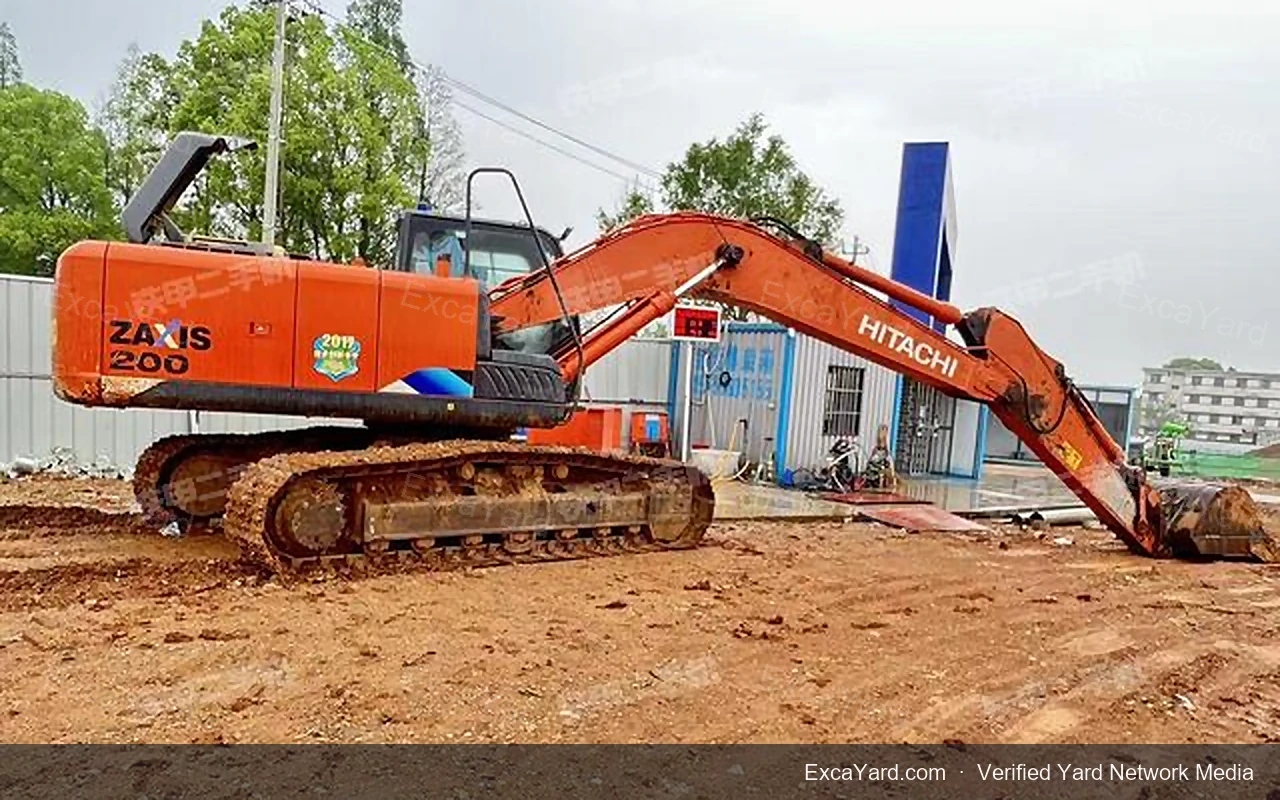
Used Hitachi ZX200-5A from China: Export Checklist for 20-Ton Excavator Buyers
Used Hitachi ZX200-5A from China for contractors and machinery importers: hydraulic pump checks, hour verification, undercarriage wear, spare parts and CIF quote keywords for 20-ton excavator buyers.