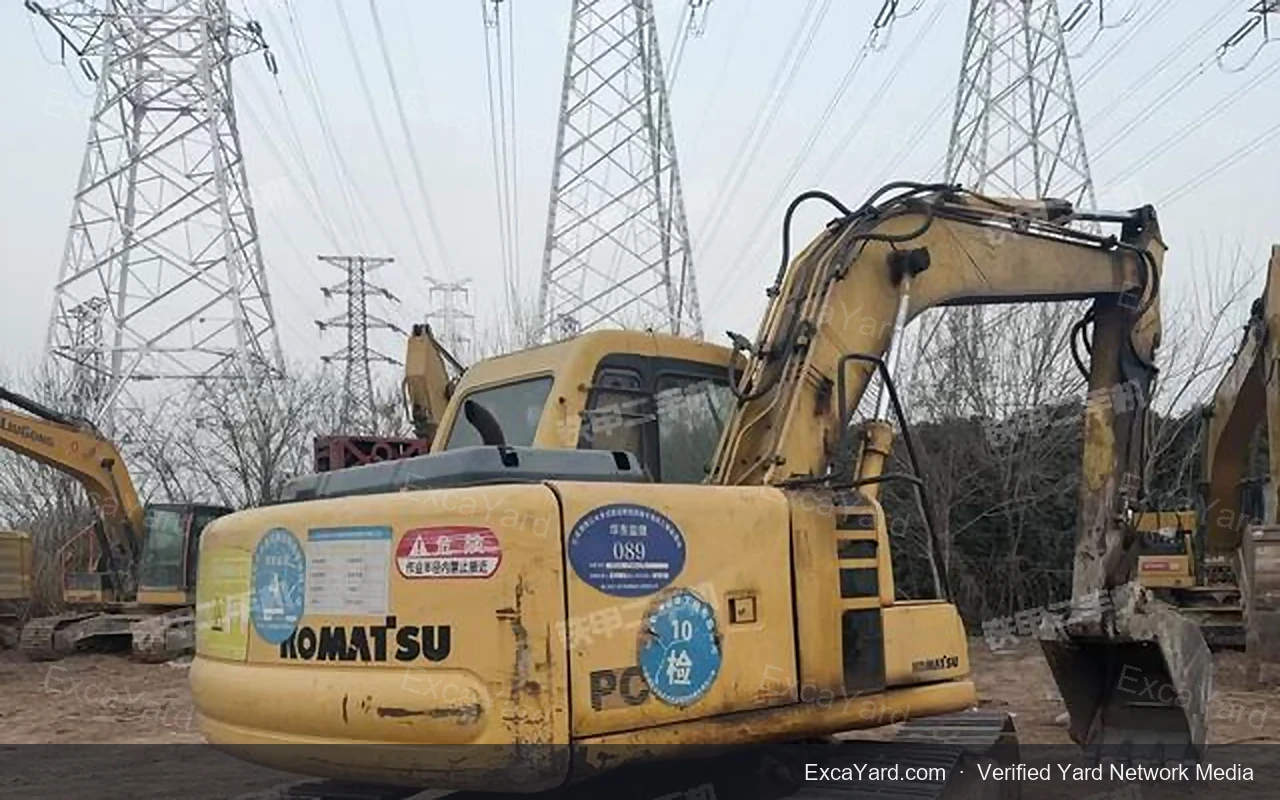
Used Komatsu PC240LC8M0 Excavator: Why 24 Tonnes Costs Less Than 20
A used Komatsu PC240LC8M0 excavator at $22,000 sits $5,500 below a 2020 PC2008M0 with fewer hours. Where the inversion comes from, who should exploit it, and the inspection that protects you.
A used Komatsu PC240LC8M0 excavator at $22,000 should not be cheaper than a smaller machine of the same year, and yet it is. Both units below are 2020 builds, both are Grade A, and both are held in partner yards in Beijing. The 24-tonne unit at 5,600 hours asks $22,000. The 20-tonne PC2008M0 at 3,600 hours asks $27,500. The larger machine with the bigger bucket is 20% cheaper than the smaller one.
That is a price inversion, and it is not a typo. It is also not a free lunch. Inversions like this appear whenever a market prices machines by the hours on the meter and the depth of the buyer pool rather than by the metal involved. Understanding where the discount comes from tells you whether you are the buyer who should take it, or the buyer who will discover the catch three months after the ship sails.
Two listings, one city, one year
| PC240LC8M0 | PC2008M0 | |
|---|---|---|
| Build year | 2020 | 2020 |
| Operating weight | 24.0 t | 20.08 t |
| Bucket | 1.2 m³ | 1.0 m³ |
| Meter | 5,600 hours | 3,600 hours |
| Grade | A | A |
| Ask | $22,000 | $27,500 |
| Yard | Beijing | Beijing |
| Stock | EXY-KOMAPC240LC8-184 | EXY-KOMAPC2008M0-153 |
| Stated hour check | ECU plus service records | ECU plus service log |
Every field except the last three is a specification. The last three are the story: two machines of the same age and grade, four tonnes apart, priced in the opposite order to what a first-time buyer expects.
Reading the used Komatsu PC240LC8M0 excavator price
One number does not explain a market, so look at the same pair through three lenses.
| Lens | PC240LC8M0 | PC2008M0 | What it says |
|---|---|---|---|
| Price per tonne | $917 | $1,370 | The 24-tonne is far cheaper per kilo of iron |
| Price per m³ of bucket | $18,333 | $27,500 | The bigger bucket is discounted too |
| Price per recorded hour | $3.93 | $7.64 | The 24-tonne has already given more of its life |
The first two rows flatter the larger machine. The third explains the discount, and it is the only row that speaks to remaining life. The PC240 has spent 2,000 more hours working than the PC200. At the PC200’s own rate of $7.64 per recorded hour, those 2,000 hours represent roughly $15,280 of consumed life. The market has discounted the bigger machine by $5,500, which is less than the value of the hours it has already burned.
So the inversion is real, but it is not irrational. It is a hours discount wearing a tonnage costume. The seller is not confused about what a 24-tonne machine is worth. The seller is pricing a 5,600-hour unit in a market that has a thinner queue for 24-tonne machines than for 20-tonne ones.
Four reasons the bigger machine carries the smaller number
Any explanation here is inference, not disclosed seller reasoning. But four forces are visible from the data and from how this class trades.
Hours. This is the measurable one. Two thousand extra hours on the meter is two thousand hours of pins, bushings, track and hydraulic life already spent. Buyers discount hours quickly and consistently.
Buyer pool depth. The 20-tonne class is the default excavator size across general construction, utilities, rental fleets and road work. The 24-tonne class sits in a narrower band: heavier trenching, quarry support, larger site preparation. Fewer buyers means slower sales, and slower sales mean sellers accept lower offers.
Transport friction. A 24-tonne machine is harder to move than a 20-tonne one. It narrows your options on loading method, on inland haulage and on which low-bed trailer can carry it legally. Sellers who know this price the friction in.
Fleet fit. A contractor with three 20-tonne machines can add a fourth without thinking. A contractor with three 20-tonne machines who buys a 24-tonne has to think about attachments, transport and operator habits. Friction again, and friction is always paid for by the seller in the end.
None of this is a defect in the machine. It is a characteristic of the market it trades in. If the friction does not apply to you, the discount is available to you.
Who the used Komatsu PC240LC8M0 excavator is actually for
The discount belongs to buyers whose work already sits in the 24-tonne band, and to buyers whose logistics can absorb the extra weight without drama.
The heavier trench and site-prep contractor. If your jobs regularly push a 20-tonne machine to its limit, the extra tonne and the 1.2 m³ bucket mean fewer passes and less strain. You were going to buy in this class anyway. Buying it at a 20-tonne price is simply a better entry.
The quarry and yard-support operation. Loading, stockpiling and bench work reward bucket capacity and stability. The long undercarriage on this model adds flotation and a wider working base, which is the reason the LC variant exists.
The buyer with an established low-bed route. If you already move 22- to 25-tonne equipment on a permitted route, the transport penalty that keeps other buyers away does not apply to you. That is precisely the margin the discount represents.
The replacement buyer, not the first buyer. If you already run Komatsu 20-tonne machines, adding a 24-tonne unit keeps the parts channel and the operator training familiar while adding capacity. Commonality has real cash value, and it is one of the few things you can verify before purchase.
Who should not buy it: a first-time importer with no transport plan, a rental fleet built entirely around 20-tonne demand, and anyone who needs to resell inside a year. The inversion rewards the buyer who can use it, not the buyer who hopes to flip it.
Settle the transport question before anything else
This is the step most buyers skip, and it is the step that decides whether the discount survives.
Ask the yard for the machine’s transport dimensions after preparation, the intended loading method, and the weight as shipped. Then take those numbers to your own freight forwarder, not the seller’s, and confirm three things: the method works from the loading port you are using, the receiving port can handle it, and your inland route can legally carry it from port to yard.
A 24-tonne machine that cannot leave the port economically has not been bought at a discount. It has been bought at a premium with extra steps. The transport answer is the real gate on this deal, and it is answerable in a week with two phone calls.
Where the discount hides its risk
The 2,000-hour gap is the honest core of this listing, and it concentrates risk in predictable places.
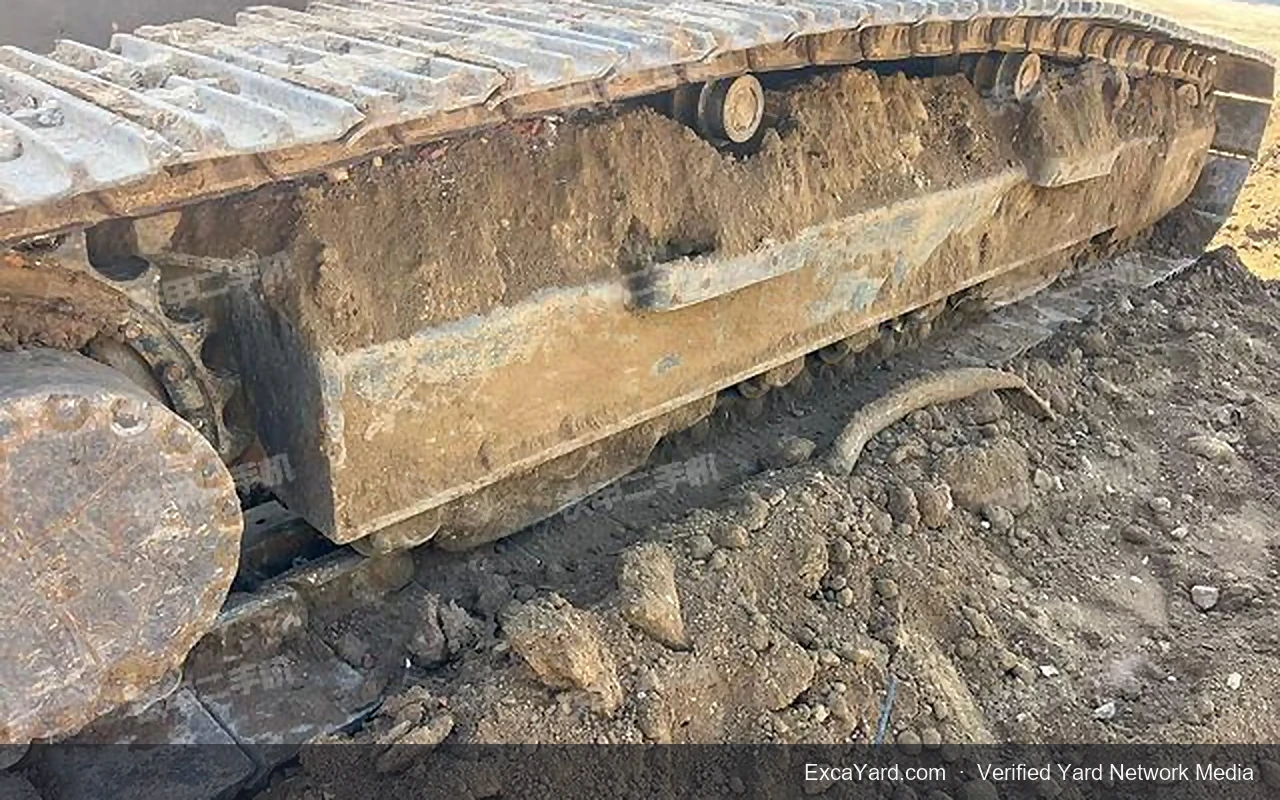
Undercarriage. At 5,600 hours, the track group is well into its wear curve. Measure chain height, sprocket teeth and roller diameter rather than trusting a description. This is the single largest line item you may inherit.
Pins and bushings. More hours means more play at the boom foot, stick nose and bucket linkage. Check with the bucket loaded and unloaded. Play that looks acceptable in the air can be alarming under digging force.
Long undercarriage geometry. The LC configuration gives stability and flotation, but it also means a longer track frame to inspect for cracks and a wider machine to move. Inspect the frame welds, not just the pads.
Hydraulics. More hours on the pumps, swing motor and travel motors. Look for seepage, listen for abnormal noise at full load, and check that travel tracks straight on flat ground. A hydraulic problem on a 24-tonne machine is the kind of repair that erases the entire discount.
Exit liquidity. If you sell in three years, you will be selling a 2020 24-tonne machine into a market that already discounts this class relative to 20-tonne units. That is not a reason to avoid it. It is a reason to buy it at a discount, which is exactly what this listing is offering.
A PC240LC8M0 inspection list
The inspection for this unit has one job: confirm that the 2,000-hour gap is the only reason for the lower price.
- Hours chain. ECU readout, dashboard, serial plate and service records in a single unbroken series. The listing states ECU plus records; ask for both as evidence.
- Undercarriage measurement. Chain height, sprocket, rollers, idlers, track tension, pad condition. Numbers, not adjectives.
- Structural welds. Boom, arm, carbody, track frame. Any repair is a price negotiation, not automatically a rejection.
- Pin and bushing play. Four linkage points, loaded and unloaded.
- Hydraulic performance. Cold start, full function cycle, travel tracking, swing brake, hose date codes, oil condition.
- Bucket and cutting edge. Wear pattern tells you what kind of work the machine actually did, which is often more revealing than the meter.
If the machine passes all six, the inversion is genuinely available to you. If it fails three, the $5,500 gap was never a discount; it was a repair estimate.
The decision rule
Use one test before you commit. Write down the three jobs you expect to put this machine on in the next twelve months. If two of them would strain a 20-tonne unit, the 24-tonne at this price is the better buy. If none of them would, you are paying to transport capacity you will not use, and the cheaper-looking machine becomes the more expensive one.
The used excavator PC240LC8M0 for sale at $22,000 is not a bargain because it is cheap. It is a bargain only if the 24-tonne class is where your work already lives.
FAQ
Why is a used Komatsu PC240LC8M0 excavator cheaper than a smaller PC200? Because the market prices hours and buyer demand, not metal. This unit has 2,000 more hours than a same-year 20-tonne listing and sits in a narrower buyer pool, so the seller has discounted it by $5,500. The 24-tonne machine is the larger asset and the shorter remaining-life asset at the same time.
Is the PC240LC8M0 price of $22,000 realistic, or is something wrong with it? It is internally consistent with the rest of the file: a 2020 Grade A machine at 5,600 hours. The only way to know whether something is wrong is a physical inspection of the six items listed above. A price this far below its class is a reason to inspect harder, not a reason to walk away.
How much does the extra weight cost me in freight? That depends on your loading port, destination port and inland route, and it is the first thing to confirm. Ask the yard for transport dimensions and shipped weight, then get an independent forwarder quote. Do not accept the seller’s freight number as your planning basis.
What does a PC240LC8M0 inspection need to prove? That the $5,500 discount reflects hours and market depth only. Measure the undercarriage, test the hydraulics under load, check structural welds and confirm the hour chain from ECU to service records. Anything the inspection finds beyond that is a price adjustment.
Closing the gap
A used Komatsu PC240LC8M0 excavator at $22,000 with 5,600 hours is the most interesting listing in this class precisely because it breaks the expected price order. Inversions reward buyers who understand why they exist. They punish buyers who treat them as luck.
The specification and full photo set for this unit are on the used Komatsu PC240LC8M0 excavator page. For the wider range and model context, see the Komatsu brand page. If you want the transport question answered against your own port and route before you decide, send ExcaYard your destination and job profile.
Cat 320 vs Komatsu PC200: Honest Comparison for Used Buyers (2026)
Choosing between a used Cat 320 and a used Komatsu PC200? Real-world differences in fuel economy, parts availability, resale value, and operating cost for export buyers.

Used Excavator Inspection Checklist: 50-Point Field Guide for International Buyers
A practical 50-point inspection checklist for buying a used excavator from China or any export market. Engine, hydraulics, undercarriage, cab — what to actually check, common red flags, when to walk away.
20-Ton vs 30-Ton Used Excavator: Which Class Should You Buy?
20-ton (Cat 320, Komatsu PC200) vs 30-ton (Cat 330, Komatsu PC300) — payload, fuel cost, transport cost, ROI per job class. Which makes more money for export buyers?