How to Import a Used Excavator from China to the Philippines (2026 Deep Guide)
Honest 2026 guide for importing used excavators from China to the Philippines — BPS conformity, Manila / Cebu / Davao ports, 12% VAT, 5% ASEAN-China FTA duty, BOC clearance, total landed PHP/USD cost math, and the four mistakes that cost importers PHP 1.2 to 3.5 million.
The Philippines is the fifth-largest used Chinese-origin excavator import market in 2026, with an estimated 2,400 machines landing across Manila, Cebu, Davao, Subic, and Batangas each year. Most arrive for the construction, mining, and infrastructure backlog under the Marcos administration's "Build Better More" pipeline — toll-road extensions on Luzon, the Mindanao Railway groundwork, nickel and gold mining in Surigao and Masbate, and continued reconstruction work across the Visayan typhoon belt. This 2026 guide explains the BPS conformity process, the Bureau of Customs procedure, the honest landed-cost math in PHP and USD, and the four mistakes that quietly cost first-time importers PHP 1.2 to 3.5 million in unnecessary clearance fees.
Why the Philippines is a distinctive import market
Three things separate the Philippines from neighbouring ASEAN destinations like Indonesia and Vietnam:
- Multiple working ports of entry: Manila (MICT / South Harbor), Cebu, Davao, Subic, and Batangas all handle used construction equipment. This is operationally a major advantage — a Mindanao-based contractor does not need to clear through Manila and pay inland transport across Luzon and the Visayas. Direct Davao clearance is normal.
- Strong ASEAN-China FTA preferential tariff: With a valid Form E certificate of origin from the Chinese exporter, used excavators clear at 5% duty under the ACFTA framework instead of the 10% MFN rate. The Form E paperwork is straightforward but absolutely must be in the documents at landing — issued after-the-fact takes months and clearance does not wait.
- English-language commercial environment: All BOC, BPS, and BIR documents are in English. There is no language barrier for a buyer who reads commercial English — this is structurally simpler than importing into Indonesia or Vietnam, where Bahasa Indonesia or Vietnamese-language filings are routine. First-time Philippine importers consistently report lower clearance friction than first-time Indonesian importers for this reason alone.
BPS conformity and the 2026 import rules
The Philippines regulates imported used machinery under the Bureau of Philippine Standards (BPS) technical regulations, administered through the Department of Trade and Industry (DTI). Three rules that bind 2026 imports:
1. Age guidance: 15 years preferred, 20 years tolerated. The Philippines does not have a hard statutory age cap on used heavy equipment, unlike Indonesia's Permendag rule. In practice, BOC examiners flag pre-2006 builds for additional inspection, and resale liquidity collapses below 2007 build year. Source 2007 or newer.
2. BPS Import Commodity Clearance (ICC) — used excavators are a non-listed product (not under mandatory product certification), so a full ICC sticker is not required for typical imports. However, BPS does require a one-time Conformity Assessment for hydraulic machinery moved under heavy-equipment classification — typically handled by SGS, Intertek, or Bureau Veritas at China origin. Cost: USD 380-650 per machine, lead time 5-8 working days.
3. Importer registration with BOC — the buyer's local entity must hold an active Importer's Clearance Certificate (ICC, BOC version, separate from BPS ICC) issued by the Bureau of Customs through the Client Profile Registration System (CPRS). Lead time for first-time registration: 14-30 days. ExcaYard does not provide BOC ICC — the buyer's local clearing agent or trading company must hold it.
If any of the three are missing at landing, the machine sits in MICT or South Harbor bonded storage at PHP 850-1,400 per day (USD 15-25/day) until resolved — typically 2-3 weeks for a missing ICC or conformity report. This is materially cheaper than Tanjung Priok in Indonesia or Apapa in Nigeria, but the delay still costs USD 300-500 in addition to demurrage.
Realistic 2026 landed-cost math: a Grade B PC200-8 to Manila
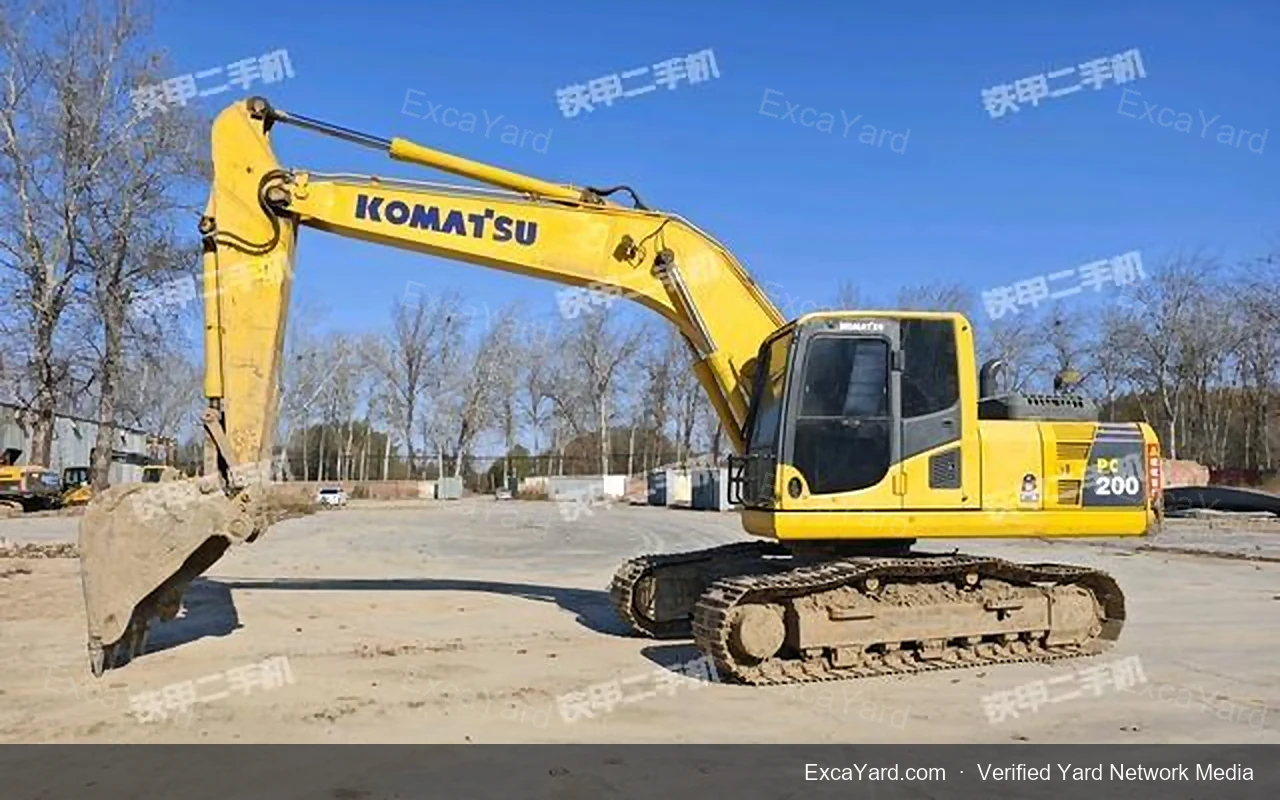
Worked example. Komatsu PC200-8, 2014 build year, 7,800 hours, Grade B condition (working machine, cosmetic wear, no major component overhaul required), Hangzhou yard.
| Cost item | USD | PHP @ 56.5 |
|---|---|---|
| FOB Shanghai (Grade B, 2014 PC200-8) | 32,500 | 1,836,250 |
| Ocean freight Shanghai → Manila (RoRo, 16 days) | 2,400 | 135,600 |
| Marine insurance (0.45% CIF) | 165 | 9,323 |
| CIF Manila value | 35,065 | 1,981,173 |
| BOC import duty (5% ACFTA with Form E) | 1,753 | 99,059 |
| VAT (12% on CIF + duty) | 4,418 | 249,628 |
| BOC processing fees and assessments | 425 | 24,013 |
| Conformity Assessment (SGS / Intertek) | 520 | 29,380 |
| Clearing agent fee (Manila) | 480 | 27,120 |
| Inland transport Manila → Bulacan (typical) | 350 | 19,775 |
| Total landed Manila / Bulacan | ~42,800 | ~2,418,200 |
| Landed cost as % of FOB | +32% | |
For comparison, the same machine landed Kenya is USD 51,000-55,000 (+57% on FOB) and landed Nigeria is USD 56,000-62,000 (+72% on FOB). The Philippines is genuinely one of the cheapest legal landed-cost destinations for used Chinese excavators in 2026, driven entirely by ACFTA preferential duty and the short ocean freight.
A Grade A 6,200-hour PC200-8 with the same paperwork lands Manila at approximately USD 49,500-52,000. A Grade C 11,000-hour machine lands at USD 35,000-37,000 — the lowest legal entry price for a working 20-ton class machine in 2026.
The four mistakes that cost first-time importers six figures in PHP
Field-observed across the 2024-2026 ExcaYard buyer cohort. None of these are exotic — all four are routine traps.
Mistake 1: No Form E at landing
The Form E certificate of origin must be issued by China Council for the Promotion of International Trade (CCPIT) at the time of shipment. It cannot be retroactively issued once the bill of lading is cut. A missing Form E means the importer pays 10% MFN duty instead of 5% ACFTA — on a USD 35,000 CIF machine, that is USD 1,750 extra duty plus VAT cascade of approximately USD 210 — about PHP 110,000 wasted on paperwork that takes the Shanghai exporter 90 minutes to file. Insist on Form E before signing the proforma.
Mistake 2: Trying to clear without a registered BOC importer
The Philippines has tightened CPRS registration enforcement since 2023. A non-registered importer cannot file an Import Entry and Internal Revenue Declaration (IEIRD) at MICT or any other port. Some informal "clearing services" promise to file under their own registration — this is a documented compliance violation that has triggered BOC audit holds on the machine and on the buyer's future shipments. Get the importer registration done properly. Lead time 14-30 days; pay the PHP 8,000-15,000 BOC filing properly.
Mistake 3: Believing the FOB price is the landed price
The most common error among first-time Filipino buyers is treating the Shanghai FOB quote as the total cost. As the cost table above shows, landed Manila is approximately FOB plus 32%. Brokers in Quiapo and Manila Chinatown sometimes show only FOB quotes — that is not malice, it is the trade convention, but the buyer must add 30-35% in the head before deciding affordability. ExcaYard quotes landed Manila and landed Cebu directly as standard.
Mistake 4: Skipping the China-origin conformity inspection
A small saving (USD 400-600) at origin turns into a USD 2,500-5,000 problem at MICT if the BOC examiner requests a domestic inspection because the documentation is incomplete. The domestic inspection involves crane-off, unscheduled testing, and a delay of 7-14 working days. Always do the SGS or Intertek conformity inspection at China origin. The PHP 25,000-35,000 cost is the cheapest insurance the import file carries.
Manila, Cebu, Davao — which port to choose?
The choice of port of entry is operationally important and affects total cost by USD 400-1,200.
- Manila (MICT / South Harbor): Default. Highest throughput, most clearing agents, deepest secondary market. Best for Luzon-bound machines and for buyers who plan to inspect physically before final inland transport. Demurrage clock starts at hour 0 and runs aggressively after day 5 of free storage.
- Cebu: Second-busiest. Good for Visayas-bound machines (Negros, Panay, Bohol). Slightly higher per-machine handling cost but no inland transport across the islands. Shorter clearing agent bench than Manila — pre-arrange the agent before bill of lading is cut.
- Davao: Best for Mindanao-bound machines (Surigao mining, Cotabato agriculture, Cagayan de Oro construction). Avoid the Manila → Davao roll-on transit cost of USD 1,400-1,900 per machine. Davao BOC is competent and used to construction equipment — examiners know what a PC200-8 looks like.
- Subic: Niche. Sometimes preferred by Bataan and Zambales contractors. Lower throughput; fewer clearing agents. Acceptable if the contractor has an existing Subic-based broker.
- Batangas: Newer port of entry for heavy equipment. Used by some southern Luzon mining and quarry operators. Acceptable for routine clearance; less established for non-standard documentation issues.
For first-time buyers, Manila is the safest choice unless the final use location is clearly in Mindanao or central Visayas. The marginal cost of inland transport from Manila to Cebu or Davao is substantial — make the port choice with the inland leg in mind.
Payment and currency mechanics
The standard payment mechanic for Philippine-bound used excavator imports in 2026 is T/T (telegraphic transfer / SWIFT) in USD from the buyer's Philippine bank to the Chinese exporter's Bank of China account. Two transfer points are normal:
- 30% deposit on order confirmation — locks the specific machine VIN, triggers China-origin inspection and Form E filing.
- 70% balance on Bill of Lading copy — typically 3-5 working days before the vessel arrives Manila.
L/C (Letter of Credit) is available for higher-value orders (USD 100,000+) but the LC issuance fee from a Philippine commercial bank (BDO, BPI, Metrobank typical) is approximately 0.5-0.8% per quarter — usually not worth the extra cost on a single-machine deal. Wise multi-currency transfers are increasingly used by smaller importers for the deposit leg; the transfer cost is materially lower than SWIFT for amounts under USD 50,000.
Forbidden payment methods: any crypto-asset wire, any informal hawala / padala arrangement, any cash settlement on landing. These trigger Anti-Money Laundering Council (AMLC) review and the import file is held.
ExcaYard's role in a Philippine import
ExcaYard is a Chinese verified-yard intermediary, not a Philippine clearing agent. The division of work is:
- ExcaYard handles in China: yard verification, machine VIN and hour-meter cross-check (see [[used-excavator-hour-meter-fraud-spot-it-2026]]), Form E filing through CCPIT, SGS / Intertek conformity inspection arrangement, Bill of Lading preparation, deposit and balance receipt.
- Buyer's local clearing agent handles in Manila / Cebu / Davao: IEIRD filing, duty and VAT payment, BPS conformity report verification, BOC physical examination if requested, release order, inland transport coordination.
ExcaYard maintains working relationships with three Manila-based clearing agents (Pier 13, MICT-adjacent, Quezon City office) and one each in Cebu and Davao. Introduction is free; commercial terms are between the buyer and the agent. ExcaYard does not take an inland transport margin.
FAQ
What is the cheapest legal way to import a used PC200-8 to the Philippines in 2026?
Source from a CCPIT-registered Shanghai or Ningbo yard with valid Form E eligibility, ship RoRo to Manila MICT, use a CPRS-registered clearing agent, file IEIRD with Form E for 5% ACFTA preferential duty. Total landed Manila for a Grade B 7,800-hour PC200-8 is approximately PHP 2.4 million (USD 42,800) in 2026.
Can I import a 2006-built machine?
Technically yes — the Philippines has no statutory age cap on used heavy equipment. Practically, BOC examiners flag pre-2007 builds for closer inspection and the local resale market is thin below 2007. Source 2007 or newer. The price premium over a 2005-2006 unit is typically USD 1,800-3,200 at Shanghai FOB — pay it.
Do I need a Philippine company to import?
Yes. The Bureau of Customs requires importer registration through the Client Profile Registration System (CPRS), and only a registered legal entity (sole proprietorship, partnership, or corporation) can hold an ICC. Individuals cannot import commercial-class heavy equipment for resale. A sole proprietorship registered with DTI is the lightest legal structure — registration fee approximately PHP 4,000.
Why is the Philippines cheaper to land in than Kenya?
Three reasons: (1) ACFTA preferential tariff (5% duty vs Kenya's 25% MFN), (2) shorter ocean freight (16 days Shanghai → Manila vs 28-35 days to Mombasa), (3) lower terminal handling fees at MICT vs Mombasa. The combined effect is 30-45% lower landed cost for the same FOB Shanghai spec. Mombasa is structurally the highest-cost African landing point for Chinese-origin equipment in 2026.
Can I clear at Cebu or Davao directly?
Yes. Both Cebu and Davao have full BOC import desks and BPS-recognised clearing agents. Direct clearance at the destination port saves USD 1,400-1,900 per machine versus Manila landing plus inland roll-on. Pre-arrange the clearing agent before the bill of lading is cut — Cebu and Davao have fewer agents than Manila, and a last-minute search delays release.
What is the typical resale retention after one year?
For Grade B Komatsu and Caterpillar 20-ton class machines, 12-month resale retention is approximately 78-86% of landed cost when sold to another contractor or via Manila's secondary market (Sucat / Parañaque equipment row). Sany and Doosan units retain 65-75% — narrower buyer pool affects liquidity. Heavy-utilisation mining-use machines in Surigao depreciate faster: 60-70% retention at 12 months.
How does ExcaYard handle warranty and post-landing issues?
ExcaYard provides a 30-day post-landing operational warranty covering hydraulic pump, swing motor, travel motor, and engine. Defects within 30 days that prevent normal working operation are remedied by the originating yard at no buyer cost (component swap or partial credit). After 30 days, the buyer's local mechanic handles. WhatsApp the ExcaYard service line at +86 19392777259 for any post-landing issue.
References
This guide draws on the Department of Trade and Industry's published BPS technical regulations for hydraulic machinery, Bureau of Customs CMTA (Customs Modernization and Tariff Act) implementing rules updated through 2025, the ASEAN-China FTA Form E rules of origin, and ExcaYard's own 2024-2026 shipment file of 73 documented Manila / Cebu / Davao clearances. For the corresponding Indonesia process see [[how-to-import-used-excavator-to-indonesia-2026]]. For Kenya see [[how-to-import-used-excavator-to-kenya-2026]]. For Nigeria see [[import-used-excavator-to-nigeria-2026]].
Buyers with active inquiries should reach the ExcaYard sales line on WhatsApp at +86 19392777259 (8619392777259) for current Shanghai and Ningbo yard inventory and live landed-Manila quotes. Quotes are valid for 7 days and lock the specific machine VIN against the buyer's name for the deposit period.

Cat vs Volvo Used Excavator: Honest Comparison for Export Buyers (2026)
Caterpillar vs Volvo used excavators — fuel economy, parts availability, resale value, and operating cost compared. Which to buy for African or Southeast Asian markets?
20-Ton vs 30-Ton Used Excavator: Which Class Should You Buy?
20-ton (Cat 320, Komatsu PC200) vs 30-ton (Cat 330, Komatsu PC300) — payload, fuel cost, transport cost, ROI per job class. Which makes more money for export buyers?
Sany vs XCMG Used Excavators: Chinese-Brand Comparison Guide
Sany vs XCMG used excavator comparison — quality, parts availability, dealer network, resale value. Honest take on the two largest Chinese OEMs for export buyers.