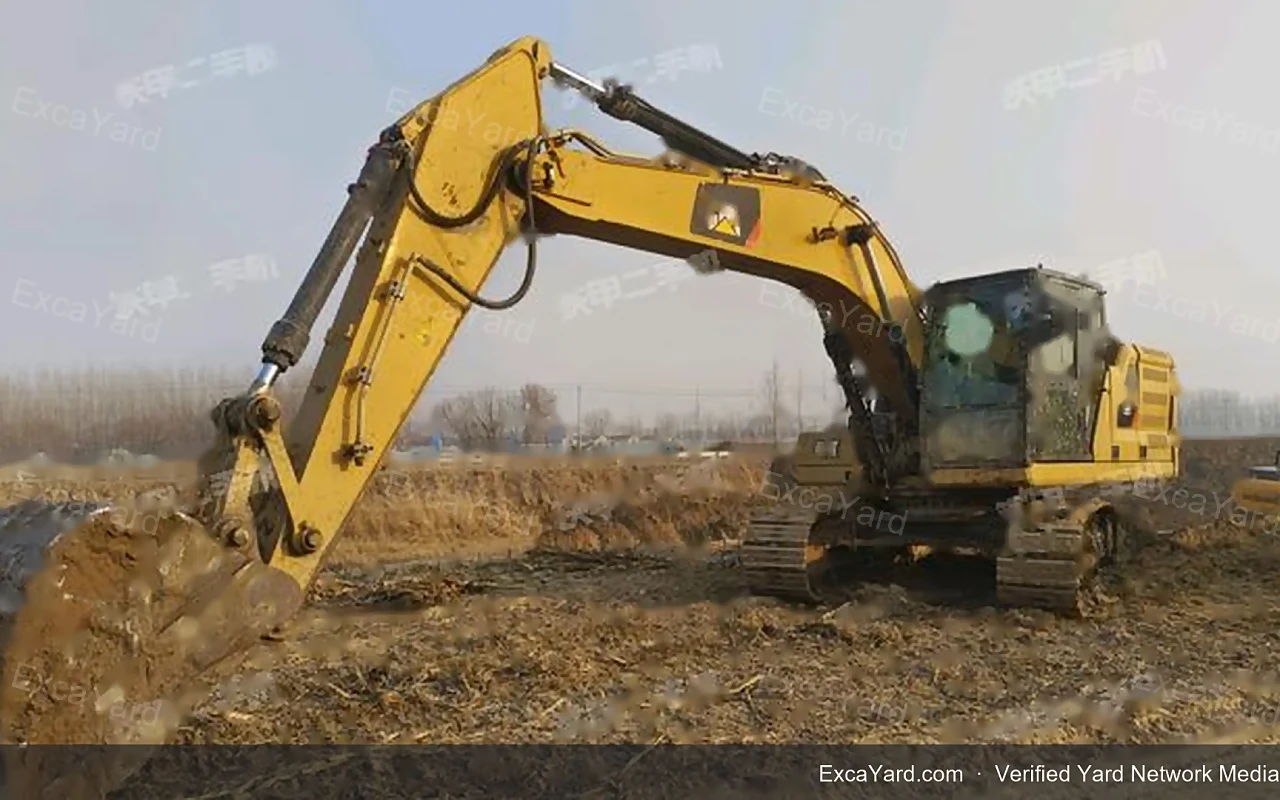
Used Caterpillar 3055E2 Excavator: Production vs Transport Economics
A 2020 used Caterpillar 3055E2 excavator listed at 30.55 t, 4,000 h and $38,000. How to balance bucket output against flat-rack freight, dismantling and price-per-hour checks.
Most buyers who shortlist a used Caterpillar 3055E2 excavator are solving two problems at the same time. They need more bucket than a 20-tonne machine can carry, and they have not yet priced what moving 30.55 tonnes does to the landed cost. Those two costs pull in opposite directions, and the purchase price sits in the middle of the argument.
The unit behind this article is a 2020 machine with 4,000 meter hours, a 1.53 m³ bucket, Grade A disclosure and a listed price of $38,000, presented from a partner yard in Zhengzhou. Nothing below invents a service history. The point is the arithmetic to run before wiring a deposit, and the checks that decide whether it survives contact with the machine.
The used Caterpillar 3055E2 excavator, reduced to verifiable fields
| Field | Recorded value |
|---|---|
| SKU | EXY-CATE3055E2-035 |
| Model year | 2020 |
| Meter hours | 4,000 |
| Operating weight | 30.55 t |
| Bucket capacity | 1.53 m³ |
| Condition grade | A |
| Price | $38,000 |
| Location | Zhengzhou, China |
Two absences matter as much as the entries. No engine model is recorded, so this article will not name one. No undercarriage percentage is published either, which is normal for a card-level listing but not enough to approve a purchase. Those gaps are closed by the inspection, not by assumption.
This used Caterpillar 3055E2 excavator listing is one unit in a wider inventory, and the same method applies to any 30-tonne candidate you shortlist.
Production: what a 1.53 m³ bucket actually changes
Bucket size is the reason to enter this weight class. A 1.53 m³ bucket moves more material per pass than the 1.0 m³ tools common on 20-tonne machines, and for a fixed truck fleet that difference shows up as fewer passes per load. Fewer passes means less swing time, less fuel burned per cubic metre and less track wear per shift.
Pass count converts into production only under four conditions:
- The haul trucks match the bucket. A large bucket over small trucks produces heaped loads, spillage and slow loading, not output.
- The bench or trench is wide enough for the tail swing. A 30.55 t machine needs room the 20-tonne class does not.
- The operator can use the extra capacity without stalling the cycle.
- The material is diggable without blasting or ripping, where the larger tool earns its keep.
If any one of those fails, the machine does not produce more per hour. It produces the same output while burning more fuel, which is the worst version of the deal. Buyers already running a 20-tonne fleet should ask what their trucks, haul roads and bench widths can absorb before assuming a bigger bucket is free capacity. Do not accept a production figure that arrives without a cycle time, a material description and a truck pairing.
Transport: the second invoice, and it arrives first
Freight is where the 30-tonne decision becomes irreversible. A machine listed at 30.55 t does not travel like a 20-tonne unit. It is not a container machine in the ordinary sense, and anyone who quotes you a container rate without measured dimensions is guessing.
The realistic methods are flat rack, RoRo or breakbulk. Which one wins depends on four measurements that should be sent as a drawing, not typed into a chat message:
- overall length with the boom folded or removed
- width over the tracks
- height to the top of the cab or exhaust
- transport weight, which is not the same as operating weight once the bucket is off
Ask for those numbers before comparing offers. A nominal class label tells a forwarder nothing; a dimensioned drawing tells them whether the unit fits a flat rack and whether the destination port can handle the lift.
This site does not quote freight inside a machine article, because rates move with port pairs, schedules and fuel surcharges. What matters structurally is that a bad shipping plan can cost more than the gap between two machine quotes.
Dismantle or roll on: the trade you are actually making
Every transport method is a trade between freight volume and reassembly risk.
Roll on, roll off keeps the machine assembled. It must be clean, self-propelled and able to climb the ramp under its own power, which is also an unplanned mechanical test. Port schedules are fixed, so a delayed document can push you a full sailing.
Flat rack usually requires removing the boom, the arm, or both, plus the bucket. That reduces the freight envelope and can cut the rate, but it adds a disassembly, a lifting plan and a reassembly at destination. Hydraulic lines get capped and reopened, and every step is a chance for contamination or a damaged seal.
Breakbulk can be the cleanest option for an awkward machine, and the least predictable on timing.
The cost does not end at the port. Inland movement of a 30.55 t unit is governed by axle load and width rules, and bridges, weight limits and urban curfews can turn a short haul into an expensive one. Put the destination address into the freight quote before you approve the machine.
Four thousand hours on a six-year-old machine
A 2020 unit reaching 4,000 hours has averaged roughly 670 hours a year. For a 30-tonne machine that is modest. Production machines in quarries and road packages often accumulate far more, so the low figure needs an explanation rather than applause.
Three explanations are common, and they lead to different inspections:
- Seasonal work. The machine ran hard in campaigns and sat between them. Check for long-idle problems: fuel system condition, battery age, seal hardening, rust in the tank, A/C and electrical faults that appear after storage.
- Owner-operator use. One site, one operator, gentle duty. This is the best version, but it still needs hour corroboration because the story is easy to tell.
- Meter discrepancy. The least pleasant option. Pull the ECM reading and compare it with the dash. A 4,000-hour claim on a 2020 machine is plausible, but plausible is not verified.
Wear should agree. Track link height, sprocket teeth, roller surfaces, bucket edge and pin play need to match 4,000 hours; if the undercarriage looks like 8,000, question the meter.
3055E2 price per hour: a screening tool, not a verdict
Divide the asking price by the meter hours and you get $9.50 per hour for this unit. Run the same division across the shortlist: a 2020 machine at 4,000 hours looks very different from an older unit at 9,000 hours for similar money.
The ratio is useful for screening and dangerous as a decision rule. It treats every hour as equal, which is false. An hour spent idling in a yard and an hour spent loading rock are not the same hour, and the ratio ignores the remaining life of the undercarriage, the pump and the engine. Use it to decide which machines deserve an inspection, not which one to buy.
What the ratio does expose is freight-blindness. A buyer comparing a $38,000 machine with a $34,000 machine and no other data is comparing the wrong numbers. Add the transport method, the dismantling cost and the reassembly time to both columns.
3055E2 inspection: where a used Caterpillar 3055E2 excavator can still fail
ExcaYard’s published grading puts Grade A at service-ready condition, undercarriage at 60% or more remaining, and no major component issues identified. That is a real filter, and it is not a warranty. A Grade A machine can still carry a repair bill that changes the deal.
For this class, look at these in order:
- Cylinder rods. Any scoring, pitting or weeping at the wiper seal is a reseal or replacement.
- Pin and bushing play. Grab the bucket and work it. Movement at the bucket, stick and boom pins multiplies through the linkage.
- Swing bearing and swing brake. Grease condition and any noise on a slow 180° swing.
- Structural welds. Boom and stick welds, plus the area around the boom foot. Repainted welds deserve a closer look.
- Hydraulic oil. A sample is worth more than an opinion. Dark oil or visible particulate points to overdue service or a failing component.
- Cooling stack. Fins packed with dust from a single dusty site will run hot under load even if the gauge looks normal in the yard.
- Pins, teeth and cutting edge. Consumables, but they add up fast on a 1.53 m³ bucket.
Ask for the inspection photos and video before the balance payment, not after. On a machine this size, one missed undercarriage item can cost more than the difference between two quotes.
Payment, documents and the handover file
Payment terms are 30% by T/T with the 70% balance before shipment, and an L/C at sight for established buyers. The balance timing is your last lever: finish the third-party inspection before it leaves, and make the report a condition of release. At handover, check the serial plate, meter photo, transport drawing, packing list and bill of lading against the machine.
Which buyer this machine suits
This unit fits a buyer with work already contracted: quarry loading, heavy road packages, large trenching, or a site where the haul fleet is sized for a 1.53 m³ bucket. In those settings the extra capacity pays for the extra freight, and 4,000 hours on a 2020 machine leaves room to earn.
It suits a rental fleet less well. A 30.55 t machine narrows your customer list, needs a low-bed for every move, and sits idle between jobs that can justify it. Without the contract in hand, look at the 20-tonne class first and revisit this decision when the work is signed.
Compare the Caterpillar range before you settle on a class, then send the job description rather than a model number. Matching the machine to the work is cheaper than correcting the mistake later.
FAQ
Is the 4,000-hour reading on this used Caterpillar 3055E2 excavator verified? The figure is recorded from the machine’s meter and rechecked with the seller at inquiry. At this value, commission an independent check that compares the dash reading with the ECM and the wear pattern.
What does the $38,000 cover? It is the machine price in the listing. Freight, insurance, destination charges, inland transport and commissioning are separate.
Can this machine ship in a standard container? Do not assume it can. At a listed 30.55 t, the method should be decided from measured dimensions and transport weight, not from the model name.
What are the payment terms? 30% deposit by T/T, 70% before shipment, with an L/C at sight available for established buyers.
Are parts a problem for a 3055E2 in an export market? Caterpillar’s parts network is broad. Confirm local dealer or aftermarket supply for filters, seals and undercarriage before you buy, and budget a first service kit.
Where can I compare used excavator 3055E2 for sale units? Start with the Caterpillar inventory and sort candidates by meter hours, grade and shipping method rather than by price alone.
Send the measurements, not the model name
If this machine matches the work in front of you, ask for the dimensioned transport drawing, the serial plate photo and the inspection media in one package. If it does not, describe the job — trucks, material, bench width, annual hours — and the shortlist can be rebuilt around the work instead of the badge. Contact the ExcaYard team.
Cat 320 vs Komatsu PC200: Honest Comparison for Used Buyers (2026)
Choosing between a used Cat 320 and a used Komatsu PC200? Real-world differences in fuel economy, parts availability, resale value, and operating cost for export buyers.

Used Excavator Inspection Checklist: 50-Point Field Guide for International Buyers
A practical 50-point inspection checklist for buying a used excavator from China or any export market. Engine, hydraulics, undercarriage, cab — what to actually check, common red flags, when to walk away.
20-Ton vs 30-Ton Used Excavator: Which Class Should You Buy?
20-ton (Cat 320, Komatsu PC200) vs 30-ton (Cat 330, Komatsu PC300) — payload, fuel cost, transport cost, ROI per job class. Which makes more money for export buyers?