Used Caterpillar 320D from China for Export to UAE (2026 Spec, Price, Shipping)
Honest 2026 buyer guide for used Cat 320D / 320D L / 320D2 excavators exported from China to the UAE — C6.4 ACERT engine reality, USD pricing, Jebel Ali import, ECAS conformity, GCC tariff, Al-Bahar dealer context.
The Caterpillar 320D is the operator-default and contractor-preferred 21-tonne excavator across the UAE in 2026 — a market where the federal customs structure rewards used imports at the higher end of the value scale, where Cat dealer support through Mohamed Abdulrahman Al-Bahar is the deepest in the GCC, and where contractor counterparties on Etihad Rail civil work, ADNOC infrastructure programmes, and the Dubai real estate cycle specify Cat by name. In a UAE construction economy where the dirham peg, the federal 5% customs duty, and a 5% VAT regime keep import landed cost predictable, the 320D from a verified China yard is a financially competitive way to put a credible 21-tonne machine on the project. This 2026 guide is the honest export-buyer brief on sourcing a used Cat 320D from China yards for the UAE: the C6.4 ACERT engine reality, the USD price bands, the Jebel Ali / Khalifa Port import process via ECAS conformity, and the inspection points that protect a buyer from the most expensive surprises.
The 320D in one paragraph
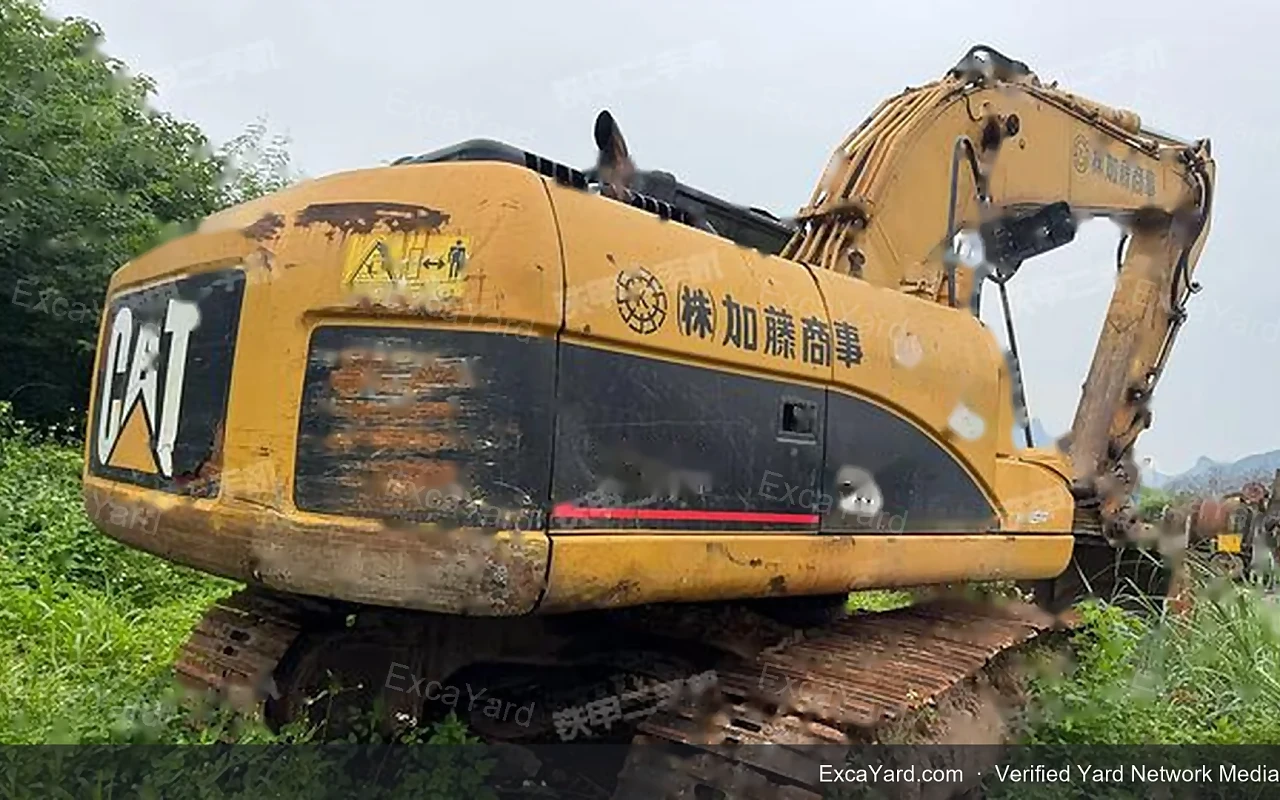
The Caterpillar 320D designation in the 2026 Chinese used-machine market is the buyer-facing shorthand for the 320D, the 320D L, and the 320D2 variants — all 21–22-tonne hydraulic excavators originally built at Cat's Akashi (Japan), Suzhou (China), and Sagami (Japan) facilities depending on year and destination. All share the Caterpillar C6.4 ACERT four-cylinder turbocharged diesel — 6.6 L displacement producing approximately 103 kW (138 hp) net at 1,800 rpm on the export-spec Tier 3 build. The ACERT (Advanced Combustion Emissions Reduction Technology) system uses internal EGR plus oxidation catalyst — no SCR, no DEF / AdBlue, no DPF on the export Tier 3 build, which is the right configuration for UAE diesel quality and ambient conditions. Production span roughly 2008 to 2014 for the volume-export 320D, 2013 to 2016 for the 320D2. Operating weight 21,300–22,500 kg, standard arm 2.93 m, bucket capacity 0.91–1.19 m³. Hydraulic system: Cat's ACS (Advanced Control System) electro-hydraulic positive-control with the Cat-branded main pump derived from the Kawasaki K3V112 family — meaning rebuild-side parts access through the standard 21-tonne ecosystem.
Why UAE buyers pick this machine
Five concrete reasons the 320D dominates the UAE 21-tonne segment in 2026:
- Al-Bahar Cat dealer network is the deepest GCC support model: Mohamed Abdulrahman Al-Bahar is the authorised Caterpillar dealer for the UAE, Bahrain, Kuwait, and Qatar — with primary facilities in Dubai (Jebel Ali), Abu Dhabi (Mussafah), and Sharjah (Industrial Area 6). Parts availability for the 320D family is genuinely 24-hour for common service items and 3–5 days for hydraulic / engine major components from the Al-Bahar regional warehouse. For an Emirati or expatriate contractor running a fleet of 21-tonne machines on Etihad Rail subcontract work or on the DP World Jebel Ali expansion, the Al-Bahar relationship is the single most important reason to default to the 320D over the Korean alternatives.
- Resale value strongest in the 21-tonne segment: A 2013 320D landed in Jebel Ali at USD 58,000 in 2026 still trades at USD 36,000–42,000 at 12,000 hours in 2029 — a five-year retained-value ratio of approximately 62–68%, the highest in the UAE 21-tonne used market. Comparable Volvo EC210 trades at 55–60%, comparable Doosan DH200 trades at 42–48%, comparable Sany SY215 trades at 30–38%. For a UAE buyer financing equipment through Emirates NBD, Mashreq, or a leasing structure, the resale strength supports better facility terms.
- C6.4 ACERT engine is robust against UAE ambient conditions: The Cat C6.4 ACERT is mechanically straightforward for the Tier 3 export spec — direct-injection turbocharged four-cylinder with internal EGR, no SCR or DPF complications. The cooling package on the 320D is sized for high ambient operation and handles UAE summer temperatures (45–48°C at Ruwais, Liwa, and inland Abu Dhabi sites) without derating concerns that affect lighter-cooled Korean alternatives. Engine parts are commodity through Al-Bahar dealer-stock and the Cat Reman programme for major components.
- Cat ACS hydraulic system tunable for breaker and milling work: The Cat ACS electro-hydraulic system supports field-programmable work modes — heavy / general / fine / breaker / shear — with auto-power-boost on demand. For a UAE contractor doing road maintenance, urban demolition, or industrial site preparation, the work-mode flexibility translates directly to operator efficiency. The Al-Bahar service team can recalibrate the ACS work modes through Cat ET (Electronic Technician) for the specific application profile.
- GCC tariff and tax regime favours upper-mid-range used imports: UAE federal customs duty on used construction machinery is 5% on CIF (the GCC common external tariff baseline), VAT is 5% (GCC VAT framework effective 2018), and there is no income tax on the operating entity. For a USD 50,000 CIF 320D, total tax burden at Jebel Ali is approximately USD 5,200 — versus USD 26,000 for the same machine landed in Mombasa under the Kenyan KRA regime. The UAE tax structure makes the 320D's premium acquisition price economically rational where it is uneconomic in higher-tax destination markets.
2026 used market prices from China yards
Honest USD pricing for export-ready 320D-class units sourced from Shanghai, Ningbo, and Qingdao yards in 2026:
- 2008–2010 320D / 320D L, 7,500–10,500 h, fair condition: USD 32,000–40,000 FOB Shanghai. Typical: 30–45% undercarriage remaining, original Cat main pump (rebuild candidate within 2,000 hours), cab refurbishment indicated, partial Cat ET diagnostic history.
- 2011–2013 320D L, 5,000–7,500 h, good condition: USD 42,000–52,000 FOB Shanghai. Typical: 50–65% undercarriage, original main pump in operating spec, no major boom welds, partial Cat ET diagnostic dump available. This is the export sweet spot for the UAE.
- 2013–2014 320D2, 3,500–5,500 h, very good condition: USD 54,000–66,000 FOB Shanghai. Typical: 65–80% undercarriage, near-original cab interior, recent oil service, full Cat ET history.
- 2015–2017 320D2 L late production: USD 68,000–84,000 FOB Shanghai. Scarce in China yards in 2026 — most retained for domestic Chinese fleet operation.
Add approximately USD 3,200–4,400 for ocean freight Shanghai to Jebel Ali, and approximately USD 1,800–2,800 for ECAS conformity, federal customs duty / VAT, terminal handling at Jebel Ali Port, and intra-UAE low-loader. Total landed cost in Dubai / Sharjah / Abu Dhabi for a 2013 320D L at 6,000 hours therefore sits in the USD 54,000–66,000 band, all-in, in 2026 — approximately USD 6,000–9,000 above the equivalent Volvo EC210 landed price and approximately USD 9,000–12,000 above the equivalent Doosan DH200 landed price.
Inspection points before you wire the deposit
The ten highest-impact inspection points for a Cat 320D-class machine sourced in China:
1. Hour meter cross-check vs Cat A4:M1 / A5:M1 ECM (engine control module): Pull the ECM history with Cat Electronic Technician (Cat ET) and verify dashboard hours, engine ECM hours, and the Implement ECM hours agree within 50 hours. A 6,000-hour dashboard reading with 8,200 ECM hours is a yard that has rolled back the cluster — the ECM history is the structural truth.
2. Main hydraulic pump pressure test: Cat main relief pressure for the 320D class should be 350 kgf/cm² at full load. Below 320 kgf/cm² indicates pump rebuild — USD 6,500–8,500 through Al-Bahar Cat parts in Dubai (genuine Cat pump rebuild), USD 4,200–5,500 through the Jebel Ali grey-market K3V112-equivalent rebuild shops; USD 3,500–4,800 in China before shipping.
3. Undercarriage wear measurement: Track shoes, link pitch, sprocket teeth, bushing diameter. Cat undercarriage uses the standard 21-tonne pattern; Cat genuine undercarriage commands a 40–60% premium over Berco / ITM / Korean DRB alternatives. Below 35% remaining is a USD 9,500–13,500 future cost on Cat genuine parts, USD 6,500–9,500 on aftermarket.
4. Boom and arm weld inspection: Magnetic-particle test on the boom box-section critical welds. The 320D boom design is structurally robust and crack history is low — but the bucket cylinder bracket on heavy demolition or quarry units should be re-checked. Boom-to-arm pin bore elongation above 1.5 mm is a buyer warning.
5. C6.4 ACERT engine blowby test: C6.4 blowby should be under 28 L/min at full operating temperature. Higher means piston ring wear and a USD 6,500–9,500 engine rebuild approaching — the ACERT components (injectors, turbo, EGR cooler) add cost premium over conventional Tier 2 alternatives.
6. Cat ET full diagnostic pull: Work mode distribution (heavy / general / fine / breaker / shear), engine idle ratio, fault history, fuel rail pressure history, EGR system events. A machine showing significant breaker-mode hours is a former demolition or shear unit and the hydraulic circuit has been stressed beyond normal.
7. Cat ACS implement controller verification: The Implement ECM on the 320D controls work-mode behaviour, attachment programming, and fine-modulation calibration. Verify the work-mode programming is intact and that breaker / shear mode events are within OEM rated cycles. ACS controller replacement USD 2,800–4,200 through Al-Bahar.
8. Travel motor swash plate condition: A common 21-tonne failure across the Kawasaki K3V112-paired family including the 320D Cat-branded equivalent. Symptom: machine drifts under straight-line travel on hard ground. Repair USD 3,200–4,800 per side through Al-Bahar with Cat genuine parts.
9. Slew bearing play check: Excess radial play on the slew bearing (above 4 mm at the outer race) indicates bearing replacement approaching. Slew bearing replacement USD 4,200–5,800 through Al-Bahar.
10. Final drive oil sample (both sides): Metallic content above 200 ppm is imminent failure. Each Cat final drive USD 5,500–7,500 through Al-Bahar Cat genuine — significantly above the Korean / Chinese aftermarket equivalents but with documented service life advantage.
Jebel Ali / Khalifa Port import process and ECAS
UAE conformity assessment for used construction machinery imports is handled through ECAS (Emirates Conformity Assessment Scheme) administered by the Ministry of Industry and Advanced Technology (MOIAT, which absorbed ESMA in 2022). The ECAS Certificate of Conformity is the document Federal Customs Authority (or Dubai Customs at Jebel Ali) requires for clearance.
Process for a 320D in 2026:
1. China yard prepares the machine: serial plate, engine number on the C6.4 block, chassis VIN photographed and matched to the bill of lading.
2. ECAS-registered inspection company (SGS, Intertek, Bureau Veritas, TÜV Rheinland, or Cotecna as MOIAT-recognised conformity assessment bodies) books a physical visit to the Shanghai, Ningbo, or Qingdao yard. Lead time 5–8 working days.
3. Inspector verifies machine condition against the proforma invoice, issues the ECAS CoC. ECAS conformity fee approximately USD 380–580 per machine in 2026.
4. Machine ships under the CoC reference. The ECAS certificate is uploaded to the MOIAT portal for Customs query at Jebel Ali, Khalifa, Mina Zayed, or Sharjah port of entry.
Always insist on the ECAS CoC scan before paying the yard's final balance. ECAS non-compliance at Jebel Ali triggers re-inspection at typically 1.8–2.2× cost premium plus terminal storage at USD 35–55 per day plus potential Customs hold until resolved.
Other UAE import notes:
- Federal customs duty + VAT: 5% federal customs duty on CIF (GCC common external tariff baseline for used construction machinery under HS 8429.52) + 5% VAT on CIF + duty. Total tax on a USD 50,000 CIF 320D is approximately USD 5,200. Confirm current rates with your UAE-licensed clearing agent at purchase time.
- Importer registration: The importer (your UAE buying entity) must have an active trade licence appropriate for construction machinery and an Importer/Exporter Code (IEC) registered with Dubai Trade or Abu Dhabi Customs. Free zone entities (JAFZA, KIZAD) handle import under their respective free zone customs frameworks.
- No income tax / personal tax on operations: UAE federal corporate tax (9% above AED 375,000 net profit) applies from 2023 onwards to UAE-incorporated entities; free zone qualifying activities may remain at 0% — confirm with a UAE tax advisor. Personal income tax remains 0%.
Shipping options and transit times
Two practical options for Shanghai → Jebel Ali shipping a 320D-class machine in 2026:
- RoRo (Roll-on / Roll-off): Approximately USD 3,200–4,400 per machine, transit 18–26 days Shanghai to Jebel Ali. Direct sailings on Höegh Autoliners, Wallenius, and NYK rotations — Jebel Ali is one of the largest RoRo terminals in the world and direct China connectivity is the strongest of any African or Gulf destination served from Chinese yards.
- 40-ft High Cube Container: Approximately USD 4,200–5,400 per machine, transit 22–32 days. The 320D L fits a 40HC with boom and arm partially demobilised; the 320D2 is similar.
Jebel Ali / Khalifa Port intra-UAE low-loader transport for a 320D-class machine:
- Jebel Ali to Dubai metro: approximately USD 240–380, same-day transit.
- Jebel Ali to Sharjah Industrial Area 6 / Hamriyah: approximately USD 320–420, same-day transit.
- Jebel Ali to Abu Dhabi (Mussafah): approximately USD 580–780, transit 0.5 days.
- Jebel Ali to Ras al-Khaimah (RAK Industrial): approximately USD 480–620, same-day transit.
- Jebel Ali to Fujairah East Coast: approximately USD 620–780, transit 0.5 days.
- Jebel Ali to Ruwais (ADNOC industrial corridor): approximately USD 780–1,100, transit 0.5–1 day.
- Khalifa Port to Abu Dhabi city: approximately USD 320–420, same-day transit.
Worked example: 2012 320D L, 6,000 h, landed Sharjah Industrial Area 6
A realistic 2026 landed cost worksheet for the 320D L sweet spot:
- China yard purchase (Qingdao, 320D L, 6,000 h, 60% undercarriage, Cat main pump original, partial Cat ET history): USD 48,000 FOB
- Ocean freight (RoRo Shanghai – Jebel Ali): USD 3,900
- ECAS conformity certificate (SGS): USD 480
- UAE federal customs duty (5%) + VAT (5%) on CIF: approximately USD 5,300
- Jebel Ali terminal handling + 5 days free storage: USD 420
- Clearing agent fees + IEC administration: USD 280
- Jebel Ali to Sharjah Industrial Area 6 low-loader: USD 380
- Total landed Sharjah Industrial Area 6: approximately USD 58,760 in 2026
That positions the 320D L approximately USD 5,000–7,500 above the equivalent Volvo EC210 landed price, approximately USD 8,500–11,500 above the equivalent Doosan DH200 landed price, and approximately USD 13,000–16,500 above the equivalent Sany SY215 landed price — a premium that pencils against the Al-Bahar service network, the 62–68% five-year retained value, and the contractor counterparty preference on Etihad Rail and ADNOC project work.
FAQ
How does the 320D compare to the Komatsu PC200-8, Volvo EC210, and Doosan DH200 for the UAE?
For the UAE, the 320D wins on dealer service network (Al-Bahar is structurally the deepest GCC Cat dealer), on resale value (62–68% at 5 years versus 55–60% for Volvo, 42–48% for Doosan, 30–38% for Sany), and on contractor counterparty acceptance (Etihad Rail, ADNOC, DP World projects specify Cat by default). It loses on acquisition cost — approximately USD 5,000–7,500 above Volvo, USD 8,500–11,500 above Doosan, USD 13,000–16,500 above Sany at landed UAE cost. The UAE tax regime (5% duty + 5% VAT, no income tax on free zone qualifying activities) reduces the working-cost differential significantly versus higher-tax East African destinations. Best buyer profile: a UAE contractor working under Etihad Rail or ADNOC subcontract, or any contractor where dealer service network and 5-year residual value drive the equipment economics.
Are there genuine Caterpillar parts dealers in the UAE?
Yes. Mohamed Abdulrahman Al-Bahar is the authorised Caterpillar dealer for the UAE (and Bahrain, Kuwait, and Qatar), with primary facilities in Dubai (Jebel Ali), Abu Dhabi (Mussafah), and Sharjah (Industrial Area 6). Genuine Cat parts inventory is the strongest in the GCC — common service parts 24-hour, hydraulic and engine major components 3–5 days through the Al-Bahar regional warehouse. Cat Reman (factory remanufactured) is available for major components at typically 60–70% of new genuine price. For wear parts (filters, tracks, buckets, teeth) the Jebel Ali Free Zone parallel-import channel and the Sharjah Industrial Area aftermarket suppliers source Korean and Chinese alternatives at 40–55% of dealer prices. The pattern most UAE Cat operators settle into: dealer for hydraulics, engine, and electronic controllers, free-zone aftermarket for wear items.
What about re-export to Saudi Arabia, Oman, or other GCC destinations?
The UAE is a member of the GCC Customs Union with Saudi Arabia, Bahrain, Kuwait, Oman, and Qatar. Used construction equipment imported and cleared in the UAE and then re-exported intra-GCC is procedurally lighter than a separate destination import — the GCC common external tariff has been collected at the first port of entry, and intra-GCC movement uses the GCC Common Customs Law framework. For a contractor with operations in Saudi Arabia (NEOM, Red Sea Project, Diriyah) or Oman (Duqm Special Economic Zone), the UAE-first import strategy is often the optimal path. Confirm specific requirements with your UAE-licensed clearing agent and the destination-country import authority at purchase time.
How many hours is too many on a used 320D?
Practical export-grade ceiling is approximately 12,000 hours in fair condition for the 320D — among the highest in the 21-tonne class given the Cat structural and powertrain robustness. Sweet spot for export to the UAE: 4,500–8,000 hours, good condition, original Cat main pump (no rebuild) or documented Cat Reman, undercarriage above 50%, no major boom or arm welds, full Cat ET history available. For Etihad Rail subcontract work where the Al-Bahar dealer support relationship is part of the contract requirement, prioritise lower hours and original Cat components — the 5-year retained value supports the premium acquisition.
Will the 320D handle Ruwais and Liwa ambient temperatures?
Yes. The Cat C6.4 ACERT engine and the 320D cooling package are sized for high ambient operation — Ruwais summer peaks at 48°C with humidity off the Gulf, Liwa inland reaches 50°C in dry desert conditions. The 320D handles these without derating at standard work modes; for sustained heavy-mode operation above 47°C ambient, Cat ET allows engine derating thresholds to be adjusted and Al-Bahar field engineers can calibrate the cooling package fan profile. The cab AC system is robust on the 320D but expect compressor service intervals to shorten approximately 30% on dusty inland sites versus coastal Dubai or Sharjah work.
What if my 320D has a major failure within 30 days of Jebel Ali landing?
ExcaYard provides a 30-day major-fault warranty from Jebel Ali landing — covering engine, hydraulic pump, and final drive catastrophic failure. Document the fault with photo, video, and a workshop diagnosis report on the day of receipt or first start. We coordinate diagnosis with our partner workshop network in Jebel Ali Free Zone and Sharjah Industrial Area 6; for fault scenarios that require Cat ET full diagnosis, we coordinate the Al-Bahar dealer connection at buyer cost. Wear-related issues, operator-induced damage, fuel / hydraulic oil contamination from local supply, and cosmetic issues are buyer responsibility.
Next step
If the 320D is on your shortlist for a 2026 UAE project, ExcaYard runs verified yard inventory across Shanghai, Ningbo, and Qingdao with daily updated stock photos and Cat ET diagnostic dumps. Send us your spec brief (year, hours, undercarriage state, hydraulic condition, budget, destination — Dubai / Sharjah / Abu Dhabi / RAK / Fujairah / Ruwais) on WhatsApp at +86 193 9277 7259 and we will match against current stock within one working day. Jebel Ali landing typically 22–32 days from deposit. T/T, L/C, and CNY (Hong Kong) payments accepted; AED-denominated payment via UAE bank accepted on confirmed buyer profiles.
References
- Ministry of Industry and Advanced Technology (MOIAT) — Emirates Conformity Assessment Scheme — official ECAS framework covering imported used construction machinery in the UAE.
- Federal Customs Authority — federal customs duty schedule and clearance procedures for the UAE.
- Dubai Customs — Jebel Ali Port and Dubai port-of-entry clearance procedures and tariff lookups.
- Abu Dhabi Ports — Khalifa Port — terminal handling, storage, and gate-out timelines at Khalifa Port and Mina Zayed.
- GCC Standardization Organization (GSO) — GCC Common Customs Law and harmonised technical regulation framework.
- Caterpillar Inc. — manufacturer reference for the 320D family and C6.4 ACERT engine specification.
- Etihad Rail — operational reference for the UAE national rail network civil works programme.
These sources support specific claims throughout the article — ECAS procedure, GCC customs framework, port operations, and manufacturer engineering data. They are external authority sources, not commercial competitors.
Cat vs Volvo Used Excavator: Honest Comparison for Export Buyers (2026)
Caterpillar vs Volvo used excavators — fuel economy, parts availability, resale value, and operating cost compared. Which to buy for African or Southeast Asian markets?
20-Ton vs 30-Ton Used Excavator: Which Class Should You Buy?
20-ton (Cat 320, Komatsu PC200) vs 30-ton (Cat 330, Komatsu PC300) — payload, fuel cost, transport cost, ROI per job class. Which makes more money for export buyers?
Sany vs XCMG Used Excavators: Chinese-Brand Comparison Guide
Sany vs XCMG used excavator comparison — quality, parts availability, dealer network, resale value. Honest take on the two largest Chinese OEMs for export buyers.