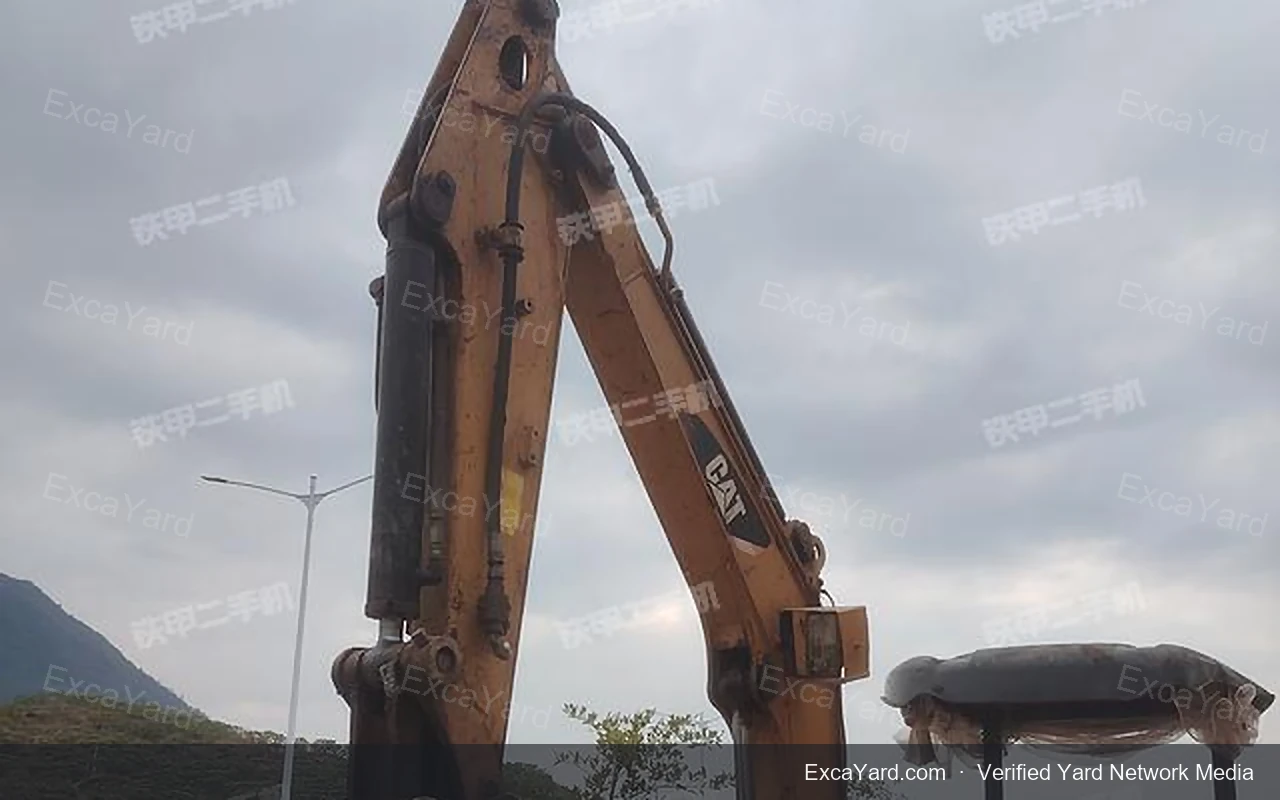
Used Caterpillar Excavator from China to Philippines: 2026 Export Guide
Honest 2026 export guide to buying a used Caterpillar excavator from China for the Philippines — which Cat models to target (320D / 320GC / 323), USD pricing, Manila import via BOC, ASEAN duty, and inspection points.
A used Caterpillar excavator is the fleet standard for a Philippine contractor — the Cat badge carries the strongest name on a DPWH, LGU, or private developer pre-qualification, holds the best resale value across Luzon, Visayas, and Mindanao, and is supported through the deepest authorised dealer network in the country via Monark Equipment Corporation, sole Cat dealer in the Philippines since 1968. The Philippine route benefits from the shortest freight transit of any major Cat destination this guide series covers (Shanghai to Manila is six to ten days), which changes the working-capital arithmetic materially. This guide is the honest export-buyer brief on sourcing a used Caterpillar excavator from China yards for the Philippines — which Cat models make sense to import, the USD price bands, the Manila import process via the Bureau of Customs, and the inspection points that protect a buyer from the most expensive surprises.
Which Caterpillar models to target from China
The Chinese used-machine market carries a broad span of Caterpillar excavators, but only a few are the right export buy for the Philippines in 2026:
- Cat 320D / 320D2 (20-tonne, the volume choice): The 320D is the single most exported Cat excavator and the right default for a Philippine buyer. It runs the Cat C6.4 (320D) or C7.1 (320D2) engine, is supported everywhere Monark reaches across Metro Manila, Cebu, Davao, and the regional branches, and holds the strongest residual of any 20-tonne machine in the Philippine secondary market. This is the model this guide centres on.
- Cat 320GC (20-tonne, value within the Cat line): The 320GC is the cost-optimised current-generation 20-tonne Cat, with the C7.1 engine and simplified hydraulics. Late-model used 320GC units appear in Chinese yards and offer the Cat badge at a lower entry than the full 320 / 323.
- Cat 323 / 323D (23-tonne, more digging force): For a contractor on heavier civils, mining site work in Mindanao, or quarry duty around Batangas and Cebu, the 323-class gives more breakout force and weight. Higher landed cost and slightly less common than the 320D in China yards.
- Cat 312 / 313 (13-tonne, lighter work): For urban site preparation in Metro Manila, subdivision development, agricultural work in the Visayan and Central Luzon plains, and lighter drainage duty, the 312/313 class is a smaller-budget Cat. Lower transport cost; not suited to heavy quarry or mining.
For most Philippine buyers in 2026 the recommendation is the Cat 320D / 320D2 at the right hours — the rest of this guide uses the 320D as the reference machine.
Why Philippine buyers pay the Cat premium
Five concrete reasons a Philippine contractor chooses a used Cat over a cheaper rival:
- Monark Equipment Corporation is the authorised Caterpillar dealer: Monark has been the sole authorised Cat dealer in the Philippines since 1968 — nearly six decades of parts inventory, factory-trained technicians, Cat reman components, and after-sales network. Its Metro Manila headquarters and regional branches across Luzon, Visayas, and Mindanao give in-country support no rival brand matches. For a contractor whose downtime is measured in DPWH milestones or developer penalty clauses, this is the core of the Cat value case.
- Strongest resale value in the Philippines: A used Cat 320D holds its value in the Philippine secondary market better than any rival 20-tonne machine. Monark's dealer footprint underwrites the resale market — a buyer who imports well and maintains the machine can exit at a materially higher percentage of landed cost than a comparable Komatsu, Hitachi, or Sany.
- DPWH, LGU, and developer tender credibility: On DPWH, MMDA-area, LGU, and large private developer tenders, an equipment schedule listing Caterpillar machines carries weight. For contractors bidding on Build-Build-Build follow-on infrastructure, subdivision development in Cavite, Laguna, and Bulacan, or Cebu and Davao urban projects, a Cat fleet is a competitive asset beyond its raw productivity.
- C6.4 / C7.1 engine support and the rebuild network: The Cat engine families are supported through Monark and the Metro Manila industrial diesel shops in Paranaque, Pasig, and Valenzuela. Cat-proprietary hydraulic components are dealer-channel through Monark, which is more expensive than the commodity Kawasaki-pump ecosystem of the Japanese brands — a cost a buyer should budget for honestly.
- Operator familiarity: Caterpillar is the most widely operated excavator brand among experienced Philippine operators, which shortens training and reduces the abuse a less-familiar machine sometimes suffers in its first months on a new site.
2026 used market prices from China yards
Honest USD pricing for export-ready Cat 320D-class units sourced from Shanghai, Ningbo, and Qingdao yards in 2026:
- 2008–2010, 9,000–12,000 h, fair condition: USD 32,000–40,000 FOB Shanghai. Typical: 320D, 30–45% undercarriage remaining, hydraulic pump a rebuild candidate, cab fair, partial service record.
- 2011–2013, 6,000–8,500 h, good condition: USD 42,000–52,000 FOB Shanghai. Typical: 320D / 320D2, 50–65% undercarriage, original Cat controllers, no major boom welds, partial ET (Cat Electronic Technician) history. This is the export sweet spot for the Philippines.
- 2013–2016, 4,000–6,000 h, very good condition: USD 53,000–66,000 FOB Shanghai. Typical: late 320D2 or early 320GC, 65–80% undercarriage, near-original cab, recent service, full ET history. Strong Philippine pick for a buyer who wants maximum life and resale.
- Low-hour late 320GC: USD 67,000–82,000 FOB Shanghai. Premium end; for buyers who want a near-new Cat at a used price.
Add approximately USD 2,000–2,800 for ocean freight Shanghai to Manila (the shortest transit in this guide series), and approximately USD 2,500–3,800 for BOC clearance, importer CPRS handling, port release, and clearing agent fees. Total landed cost at Manila before duty and VAT for a 2012 Cat 320D at 7,000 hours therefore sits in the USD 46,500–58,600 band in 2026, with the applied MFN duty and 12% VAT on the CIF value adding materially on top — the low freight and short transit make working-capital costs the friendliest of any Cat destination in this series.
Inspection points before you wire the deposit
The ten highest-impact inspection points for a Cat 320D-class machine sourced in China for the Philippines:
1. Hour meter cross-check via Cat ET: Connect Cat ET (Electronic Technician) and pull the ECM hours. Verify ECM hours, dashboard hours, and any service-record hours agree within 50 hours. A low dashboard reading against a higher ECM history is a yard that has tampered with the cluster — the most common fraud on premium machines.
2. Main hydraulic pump pressure test: Cat-proprietary main pump relief pressure should hold at the Cat spec under full load. Below spec indicates rebuild — and a Cat pump rebuild is dealer-channel through Monark, materially more expensive than a Kawasaki-pump rebuild, so budget USD 5,000–7,500 if the pump is marginal. Test it before you buy, not after.
3. C6.4 / C7.1 engine blowby test: Blowby should be modest at full operating temperature. Excessive blowby means ring wear and a USD 6,000–9,000 top-end rebuild approaching. Confirm which engine the machine carries (C6.4 on the 320D, C7.1 on the 320D2 / GC) and verify it matches the serial.
4. Cat ET full diagnostic pull: Work-mode and load history, idle ratio, fault codes, and event history. A 320D showing heavy breaker-mode hours is a former demolition unit with a stressed hydraulic circuit — verify against the work you intend across Luzon, Visayas, or Mindanao.
5. Boom and arm weld inspection: Magnetic-particle test on the boom box-section critical welds and the bucket cylinder bracket. The 320D structure is robust but heavy-quarry units accumulate stress. Boom-to-arm pin bore elongation above 1.5 mm is a buyer warning.
6. Undercarriage wear measurement: Track shoes, link pitch, sprocket teeth, bushing diameter. Cat undercarriage parts are dealer-channel through Monark (genuine) or available aftermarket; below 35% remaining is a USD 8,000–13,000 future cost on a Cat — plan for it.
7. Cab and AC test: Verify door seals, dash and monitor function, AC compressor cycling, blower, and seat condition. AC is essential in Philippine tropical conditions — humidity plus long summer duty cycles are hard on cab electronics, so budget USD 1,800–3,200 if the AC or interior needs work.
8. Final drive and travel motor (oil sample both sides): Metallic content above 200 ppm is imminent failure. Travel-motor wear shows as drift under straight-line travel. Cat final drives are dealer-channel; budget accordingly.
9. Serial and plate verification against export documents: Confirm the machine serial, engine serial, and chassis match the commercial invoice and bill of lading exactly. A mismatch will stall the Philippine import at BOC valuation and release.
10. Service history and ET event log authenticity: A genuine Cat with a clean ET history is worth the premium; a Cat with a wiped or suspicious ET log should be priced as if the worst is true. Insist on the diagnostic dump before paying the balance.
Manila import process: BOC, CPRS, and clearing
The Philippine route runs through the Bureau of Customs (BOC), with the importer registered under the Client Profile Registration System (CPRS) as a prerequisite to lodging an import declaration. The primary port for used excavator imports from China is the Manila International Container Terminal (MICT) with South Harbor as the alternative, and Batangas, Subic, Cebu, and Davao available for buyers whose end-site is closer to those ports.
Process for a Cat 320D in 2026:
1. China yard prepares the machine and documentation: serial plate, engine serial, chassis, and photographs matched to the commercial invoice.
2. Philippine-side importer completes or renews CPRS registration with the BOC, and the licensed customs broker prepares the Single Administrative Document (SAD) with the commercial invoice, packing list, bill of lading, and certificate of origin. Any product-standards documentation applicable to the HS code and shipment is prepared at this stage.
3. Machine ships to Manila (MICT or South Harbor) with the shipping documents in place.
4. On arrival, the licensed customs broker lodges the import declaration through the BOC electronic system, the machine goes through BOC valuation and clearance, the importer pays duty, VAT, and applicable fees, and the machine is released. Where the machine will move on public roads, register with the relevant road authority.
Confirm the applicable BOC procedures, HS classification, and any product-standards documentation for HS 8429.52 with your licensed Philippine customs broker before shipping — used industrial machinery is handled differently from consumer products regulated under the DTI Bureau of Product Standards (BPS), and the exact requirements can shift.
Optional pre-shipment inspection (PSI): Unlike Kenya, Tanzania, or Nigeria — where KEBS PVoC, TBS PVoC, or SONCAP are mandatory — the Philippines does not require pre-shipment conformity certification for a used excavator under HS 8429.52. Many prudent Philippine buyers still commission an optional third-party pre-shipment inspection (PSI) via SGS or Intertek at the Shanghai, Ningbo, or Qingdao yard, at their own cost, to independently verify machine condition, hour meter authenticity, and the KOMTRAX or Cat ET diagnostic pull before the balance payment. Budget USD 350–700 for an SGS or Intertek PSI on a mid-value used excavator. This is a discretionary buyer protection, not a regulatory requirement.
Other Philippine import notes:
- Duty and VAT: Used excavators under HS 8429.52 attract the applied MFN import duty (a low single-digit rate under ASEAN standards) plus 12% VAT on the landed CIF value. On a mid-range 2012 320D this is a meaningful line item but materially lower than the East African EAC common-external-tariff route. Work the exact figures with your Philippine customs broker before you commit.
- Clearing agent: Use a licensed Philippine customs broker experienced with construction machinery and BOC procedures. The broker manages the electronic import declaration, port release, and any registration steps.
- Inland transport: Budget low-loader transport Manila to Cavite, Laguna, Batangas, Bulacan, Pampanga, or upcountry. For end-sites in Cebu, Iloilo, Davao, or Cagayan de Oro, direct entry via the regional port can save a lot of inland movement and cost.
Shipping options and transit times
Two practical options for Shanghai → Manila shipping a Cat 320D-class machine in 2026:
- RoRo (Roll-on / Roll-off): Approximately USD 2,000–2,800 per machine, transit 6–10 days Shanghai to Manila. RoRo is the common choice for a self-propelled excavator, avoids container packing cost, and delivers by far the shortest transit of any destination in this guide series.
- Flat-rack container: Approximately USD 1,900–2,600 per machine, transit 10–16 days including consolidation. The 320D ships on a 40ft flat-rack with boom and arm folded; suits a buyer consolidating Cat parts or attachments in the same shipment or a buyer whose end-port is a Visayan or Mindanao container port.
Build your timeline around a deposit-to-Manila window of 20–30 days in 2026 — the shortest end-to-end window of any Cat destination in this series, which is a real working-capital advantage for a Philippine contractor timing the machine to a project start.
FAQ
Which used Caterpillar excavator should I import to the Philippines in 2026?
For most Philippine buyers the Cat 320D / 320D2 (20-tonne) is the right choice — it is the most exported Cat, the best supported through Monark Equipment Corporation, and holds the strongest resale in Metro Manila, Cebu, and Davao. The 320GC offers the Cat badge at a lower entry, the 323 gives more digging force for heavy civils and mining, and the 312/313 suits lighter urban and subdivision work. Target a 2011–2013 320D at 6,000–8,500 hours for the best balance of price, life, and residual.
Why is a Philippine Cat import faster than Kenya, Tanzania, or Nigeria?
Freight transit. Shanghai to Manila is six to ten days on RoRo — a quarter of the transit time to Mombasa, Dar es Salaam, or Apapa. The deposit-to-port window of 20–30 days is the shortest in this guide series and lets a Philippine contractor time the machine tightly to a project start, freeing working capital that would otherwise sit idle in a 40–55-day East African transit.
What documentation do I need for a used Cat excavator import at Manila?
The core stack is: commercial invoice, packing list, bill of lading, certificate of origin, and the electronic import declaration lodged by a licensed Philippine customs broker through the Bureau of Customs. Your importer must be registered under the Client Profile Registration System (CPRS). Confirm the exact BOC procedures and any product-standards requirements for HS 8429.52 with your broker before shipping.
How much will duty and VAT add on a Cat excavator into the Philippines?
Used excavators under HS 8429.52 attract the applied MFN import duty (a low single-digit rate under ASEAN standards) plus 12% VAT on the CIF value. On a mid-range 2012 320D this is materially lower than the East African EAC route but still a meaningful line item. Work the exact current figures with your licensed Philippine customs broker before you commit.
Will Monark support a China-imported used Cat in the Philippines?
Yes — Monark Equipment Corporation supports genuine Caterpillar machines regardless of import origin, supplying genuine parts, Cat reman components, and factory-trained service from Metro Manila and the regional branches. This in-country support is a core part of the Cat value case. Confirm parts availability for your specific model and serial with Monark when you plan the purchase, and budget Cat dealer-channel parts pricing into your ownership costs.
Talk to ExcaYard
If a used Caterpillar excavator is on your shortlist for a 2026 Philippine project, ExcaYard runs verified yard inventory across Shanghai, Ningbo, and Qingdao with daily updated stock photos and Cat ET diagnostic dumps. We prepare the export documentation stack — commercial invoice, packing list, certificate of origin — so your Philippine customs broker can lodge the BOC declaration cleanly. Send us your spec brief (model — 320D / 320GC / 323, year, hours, undercarriage state, hydraulic condition, budget, destination — Metro Manila / Cebu / Davao / Cagayan de Oro / Iloilo / Batangas) on WhatsApp at +86 193 9277 7259 and we will match against current stock within one working day. Manila landing typically 20–30 days from deposit — the fastest of any destination we serve. T/T, SWIFT, Wise, and L/C payments accepted.

Cat vs Volvo Used Excavator: Honest Comparison for Export Buyers (2026)
Caterpillar vs Volvo used excavators — fuel economy, parts availability, resale value, and operating cost compared. Which to buy for African or Southeast Asian markets?
20-Ton vs 30-Ton Used Excavator: Which Class Should You Buy?
20-ton (Cat 320, Komatsu PC200) vs 30-ton (Cat 330, Komatsu PC300) — payload, fuel cost, transport cost, ROI per job class. Which makes more money for export buyers?
Sany vs XCMG Used Excavators: Chinese-Brand Comparison Guide
Sany vs XCMG used excavator comparison — quality, parts availability, dealer network, resale value. Honest take on the two largest Chinese OEMs for export buyers.