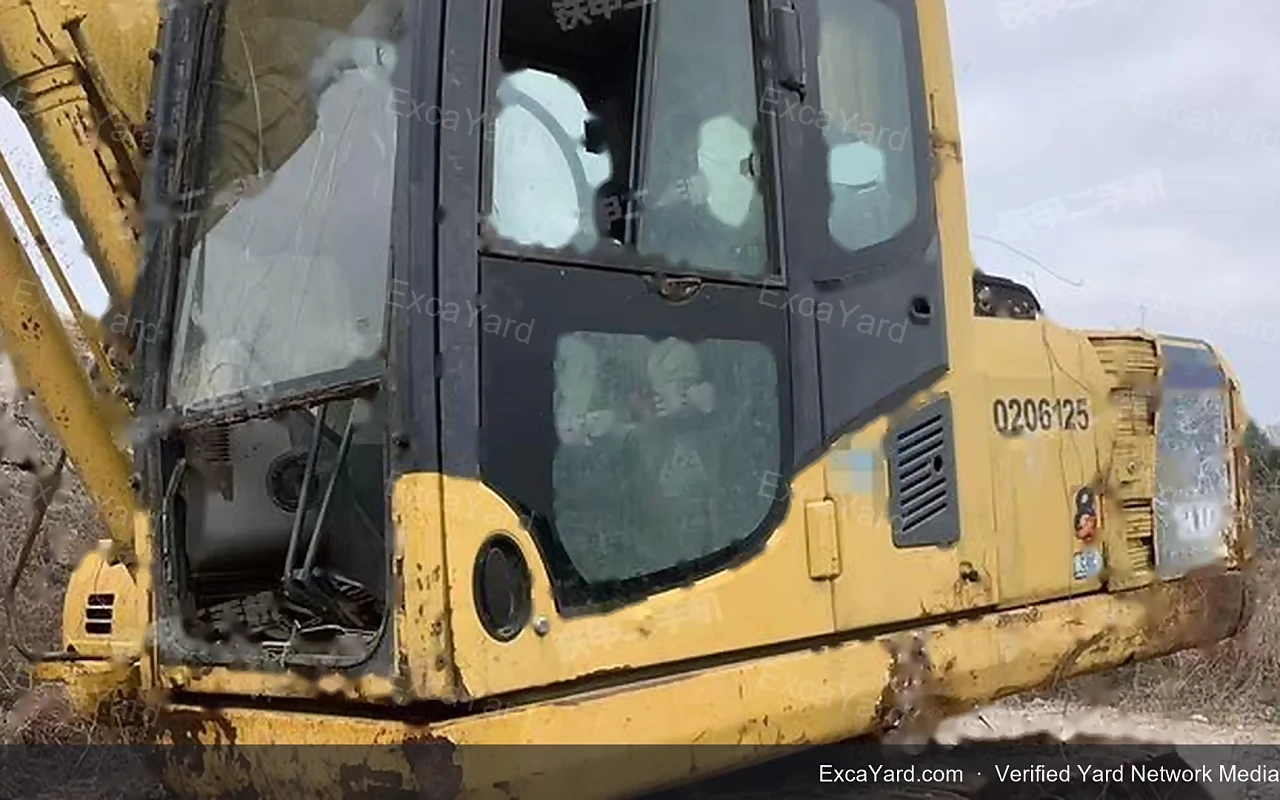
Used Excavator Hour Meter Fraud — How to Spot It Before You Buy (2026)
2026 export buyer field guide to used excavator hour meter fraud — five concrete cross-checks that catch rolled-back machines before the deposit goes out. Komatsu / Caterpillar / Hitachi / Doosan / Volvo specifics.
The single most expensive lie in the used-excavator export trade is the rolled-back hour meter. A 12,000-hour machine made to read 6,500 hours costs the unsuspecting buyer USD 15,000 to USD 35,000 in unscheduled repairs over the following 24 months — the unseen cylinder seal degradation, the worn bushings, the tired hydraulic pump that no longer holds pilot pressure. This 2026 field guide gives a buyer the five concrete cross-checks that catch rolled-back machines before the deposit wire goes out from Bank of China. None of these checks require the machine to be on your soil. All of them are non-negotiable.
Why hour meter fraud is so common in the export trade
A 20-ton class excavator like a Komatsu PC200-8 or Cat 320D loses approximately USD 3.00 to USD 4.50 of value per hour worked beyond the 5,000-hour mark. Rolling a 9,000-hour machine back to 6,000 hours therefore adds USD 9,000 to USD 13,500 to the apparent value with approximately two hours of work for a corrupt yard. The math is irresistible to the worst actors in the trade.
Hour meter fraud is rarer at reputable Chinese yards — established exporters in Shanghai, Ningbo, Qingdao, and Shantou rely on repeat-buyer relationships and do not roll meters. The fraud risk is concentrated in opportunistic intermediaries who buy from auctions, swap meters, and resell to first-time export buyers in West Africa, Latin America, and Southeast Asia. The buyer's job is to assume the meter is unreliable and verify the true hours by other evidence.
Check 1: Engine ECU / machine controller cross-read
Every modern 20-ton excavator has a machine controller that logs operating hours independently of the dashboard meter. This is the single most powerful cross-check, and any yard refusing to allow this read is hiding something:
- Komatsu PC200-8: KOMTRAX system on machines built 2008 onward, plus the machine controller (MCU). Pull both via the Komatsu service tool. A 6,000-hour dashboard reading with 8,500-hour MCU log is a yard hiding 2,500 hours.
- Caterpillar 320D / 320D2: Cat Electronic Technician (ET) reads the ECM hours directly. Cat Product Link telematics on 320D2 onward gives a third independent reading. Three-way agreement is the standard for a clean machine.
- Hitachi ZX200-5A: DR.ZX diagnostic tool reads the machine controller (ICF) operating hours. Hitachi also embeds hours into the hydraulic pump controller — that one cannot be rolled.
- Doosan DH200 / DX200: DDT (Doosan Diagnostic Tool) reads ECM hours; the e-EPOS controller has a separate hour log on DX series.
- Volvo EC210 / EC220: Volvo CareTrack telematics where active; VCADS Pro tool for offline read. Volvo's V-ECU log is particularly hard to alter.
Demand a screenshot of the diagnostic tool output during inspection, dated and showing the machine's serial number on the same screen. If the yard cannot produce this, the machine is not export-grade — walk.
Check 2: Hydraulic hose date code audit
Every hydraulic hose carries a manufacturing date code stamped or printed on the outer braid. Common formats:
- Continental / ContiTech: "Q3 2014" or "2014/09"
- Parker / Eaton: "0914" (week 09, 2014) or "Q3-14"
- Komatsu / Cat OEM: a four-digit Julian code
A genuinely worked machine with 6,000 hours has typically been hose-replaced at least once by the original owner — modern excavator hoses are rated for 4,000–6,000 hours of cyclic pressure work. A 6,000-hour-claimed machine with all original 2008 hoses has been sat in a yard, not worked — that means cylinder seals have dried, hydraulic oil has degraded, and the pump pilot seals are likely past spec. The machine may have low real hours, but it has aged badly. Either way, the dashboard reading is unreliable.
Conversely, a 6,000-hour-claimed machine with 2019 hoses and 2008 build date strongly suggests rolled-back hours after a recent hose change — the corrupt yard refreshed the visible parts to make the low reading more credible.
Check 3: Wear pattern consistency
Specific wear patterns scale predictably with real hours. Mismatch is the signature of fraud:
- Pedal and joystick rubber: A genuinely 5,000-hour machine has visible polish wear on the right joystick knob and the travel pedals. A 5,000-hour-claimed machine with brand-new rubber knobs has either been recently refurbished (acceptable, ask for the work order) or has had its hours rolled and surfaces dressed.
- Operator seat fabric and base: 5,000 hours of operator use shows seat-base sag, knee-side fabric wear, and right-armrest polish. Brand-new-looking seat on a 5,000-hour machine = refurbishment or fraud.
- Cab door step plate: A high-traffic wear point. Genuinely 5,000-hour machine has visible step-plate scuffing and pattern wear in the centre line.
- Bucket cylinder rod chrome: 5,000 hours of cycling shows micro-scratching on the rod chrome. A polished-clean rod on a 5,000-hour machine = either recent cylinder rebuild or rolled hours.
- Boom and arm grease nipple wear: The grease nipples (typically 4 on the boom-arm-bucket linkage, 2 on the swing) develop a specific tool-mark wear pattern after a few thousand hours. Brand-new-looking nipples = recent service or rolled meter.
A reliable yard provides a photo set covering these wear points alongside the meter reading. An honest 5,000-hour machine looks like it has worked 5,000 hours — that is the standard.
Check 4: Service sticker and stamped record audit
Every reputable manufacturer service centre stamps or stickers a service record at major intervals (500, 1,000, 2,000, 4,000, 8,000 hours typically). Two specific places to check:
- Inside the cab door pillar or under the seat: A sequential sticker record. The most recent sticker should be consistent with the claimed hours — a 5,000-hour machine should have stickers up to approximately the 4,000-hour service.
- Under the engine hood near the air filter housing: Some manufacturers (notably Komatsu and Hitachi) place the major-service sticker here. The Komatsu PC200-8 in particular has a known sticker location on the inside of the hood panel.
A 5,000-hour machine showing only a 1,000-hour service sticker either has not been serviced (a quality red flag of its own) or has had stickers removed to support a rolled-back hour story. A 5,000-hour machine showing a 10,000-hour service sticker is the most direct evidence of fraud you can find — the yard failed to remove the original sticker.
Check 5: Owner / fleet history via VIN trace
The chassis VIN (and the engine serial number, where separately stamped) can sometimes be traced through manufacturer dealer networks. This is the strongest cross-check available — but the most operationally difficult, and requires patience:
- Komatsu: Komtrax-equipped machines have a recorded service history at the manufacturer level. A formal request through an authorised Komatsu dealer in the destination country can produce a service summary, including the hour reading at last dealer contact. Lead time: 3–7 working days.
- Caterpillar: Cat's serial number lookup via the dealer network can produce a service summary for machines that have had any Cat dealer contact (parts purchase, warranty work, inspection). A Mantrac request in Kenya for a Cat 320D VIN typically returns within 3–5 working days.
- Hitachi: Global ConSite telematics where active; otherwise an Achelis or Hitachi global dealer request returns a service summary within 5–7 working days.
- Doosan / Volvo: Similar dealer-network query process, lead times 5–10 working days.
A VIN trace that returns "last service contact at 8,400 hours in 2023" on a yard machine claiming 5,800 hours in 2026 is a direct fraud detection. ExcaYard routinely runs these traces for high-value purchases (USD 50,000+) as part of pre-deposit due diligence. The cost is operational time, not money — and it has paid for itself many times over by killing fraudulent listings before they reach a buyer's deposit.
What to do if a yard fails one of these checks
The five checks are layered. A single discrepancy may have an innocent explanation (recent component swap, refurbished cab, unusual service pattern). Two or more discrepancies on the same machine is conclusive — walk. The investment of further due-diligence time on a multi-flag machine is almost always wasted.
If you have already paid a deposit when fraud surfaces:
1. Document every discrepancy with photos, diagnostic tool screenshots, hose date codes, and the conflicting yard claims. Date-stamp everything.
2. Demand a refund in writing via WhatsApp message thread + email. The contemporaneous record matters.
3. Escalate to the yard's bank correspondent if the deposit was wired via T/T (Bank of China can sometimes assist if fraud is documented within 30 days of wire).
4. For Wise transfers, file a dispute through the Wise platform within 60 days of the transfer.
5. For Letter-of-Credit transactions, the documentary discrepancy gives the issuing bank grounds to refuse honor — protect this paper trail.
The trade reputation cost to a Chinese yard of a publicised fraud incident is higher than the deposit they hold — most legitimate yards refund quickly when a buyer surfaces with strong evidence. The opportunistic intermediaries who commit fraud, on the other hand, rarely refund. Prevention by inspection is the only reliable defence.
What ExcaYard does in this space
ExcaYard's 150-point pre-shipment inspection includes all five of these cross-checks as a baseline. Each inspection produces a photo report covering: ECU/MCU hour read screenshot, hydraulic hose date codes, wear-point photos, service sticker locations, and VIN trace status. The report is shared with the buyer before the deposit. For purchases above USD 50,000, we recommend the buyer schedule an in-person yard visit to verify the inspection findings — typical visit 1.5 days on-site, cost approximately USD 1,400–1,800 from Mombasa, USD 1,200–1,600 from Lagos, USD 1,800–2,200 from Manila or Dammam. The visit cost is trivial relative to the protection it provides.
For destinations covered (Kenya via Mombasa, Nigeria via Lagos, Tanzania via Dar es Salaam, UAE via Jebel Ali, Philippines via Manila, South Africa via Durban, Mozambique via Beira, Saudi Arabia via Dammam, and others), ExcaYard's standard process includes KEBS PVoC / SONCAP / TBS PVoC / GCC CoC / NRCS LoA pre-shipment certification — independent inspectors who add a third-party check beyond the yard's own claims. The conformity inspection independently verifies hour meter against engine serial number, providing yet another layer of fraud detection.
FAQ
How much does hour meter fraud actually cost a buyer over the life of the machine?
A 20-ton class machine with 3,000 hidden hours typically delivers USD 15,000 to USD 35,000 of unscheduled repair within 24 months — hydraulic pump rebuild, cylinder reseal, undercarriage replacement reaching wear limit early, possible engine top-end overhaul. The buyer thought they bought a 6,000-hour machine; they actually bought a 9,000-hour machine and will pay the difference in failures.
Are reputable yards in Shanghai or Ningbo immune from this fraud?
Established Chinese yards in major export hubs (Shanghai, Ningbo, Qingdao, Shantou, Tianjin) rely heavily on repeat-buyer relationships and do not generally roll meters — their commercial model is volume across many buyers, not one-shot deception. Fraud risk is concentrated in opportunistic intermediaries who buy from domestic auctions, swap meters, and resell. The protection is to use an exporter with a verifiable track record, like ExcaYard, rather than a sourcing arrangement through an unknown intermediary.
Can I do these five checks without travelling to China?
Three of the five can be done remotely with strong yard cooperation: the ECU/MCU diagnostic screenshot (Check 1), the hydraulic hose date code photos (Check 2), and the service sticker photos (Check 4). The wear pattern check (Check 3) requires a high-resolution photo set or a video walkaround. The VIN trace (Check 5) is dealer-network based and runs from your destination country, not from China. A buyer working with ExcaYard does not typically need to travel to China for purchases under USD 50,000 if all five checks pass remotely.
What if the engine ECU has been reset or replaced?
ECU replacement is a known fraud technique on older Cat machines — install a low-hour ECU from a scrapped machine. The cross-check is the hydraulic pump controller, the swing motor controller, and the cab monitor hour log — these are rarely all replaced together because each ECU costs USD 1,500–3,500 to source. A multi-controller read showing inconsistent hours across the ECU, the hydraulic controller, and the dashboard means the ECU has been swapped. Walk.
Do Chinese auction houses verify hour meters at sale?
No. Chinese construction equipment auctions (DEC, MFY, and the major regional auctions) sell machines on an as-is, where-is basis. The auction listing reports the meter reading as observed; verification is the buyer's responsibility. This is why opportunistic intermediaries can buy at auction with rolled meters and resell — the auction itself does not certify hours.
Is hour meter fraud illegal in China?
Commercial fraud is illegal in China under PRC contract law, but enforcement against used-equipment hour rollback is operationally weak. A buyer's practical remedy is the documentary trail, the deposit refund mechanism, and (where the fraud is large enough to justify the cost) civil litigation through the Shanghai or Guangdong courts — which is impractical for most individual buyers. The reliable defence is pre-deposit inspection, not post-fact legal remedy.
Next step
If you are sourcing a used 20-ton excavator from China in 2026 and want the full 150-point inspection report — including all five hour meter cross-checks above — before you wire a deposit, talk to ExcaYard on WhatsApp at +86 150 5227 3039. Send the machine spec you are evaluating (yard, year, hours claimed, dashboard photo) and we will assess the listing against the five-check framework within one working day, at no cost. T/T, Wise, L/C, and CNY (Hong Kong) payments accepted. Mombasa, Lagos, Dar es Salaam, Jebel Ali, Manila, Durban, Beira, Dammam destinations all routine.
References
- Komatsu — Global Construction Equipment — manufacturer specifications for SAA6D107E engine and PC-series excavators.
- Caterpillar — Global product specs — manufacturer engineering data for 320D and related excavator families.
- Hitachi Construction Machinery — Global — manufacturer data for ZX-series excavators and Isuzu engine compatibility.
- SGS — Pre-shipment Inspection — third-party verification provider at China origin.
- Intertek — Government & Trade Services — PVoC inspection company operating at Chinese yards.
- KEBS Pre-Export Verification of Conformity (PVoC) — official Kenya conformity program covering imported used machinery.
- UN Comtrade Database — bilateral trade data for HS 8429.52 / 8429.59 (excavators).
These sources support specific claims throughout the article — pump specifications, port operations, tariff schedules, and manufacturer engineering data. They are external authority sources, not commercial competitors.

Cat vs Volvo Used Excavator: Honest Comparison for Export Buyers (2026)
Caterpillar vs Volvo used excavators — fuel economy, parts availability, resale value, and operating cost compared. Which to buy for African or Southeast Asian markets?
20-Ton vs 30-Ton Used Excavator: Which Class Should You Buy?
20-ton (Cat 320, Komatsu PC200) vs 30-ton (Cat 330, Komatsu PC300) — payload, fuel cost, transport cost, ROI per job class. Which makes more money for export buyers?
Sany vs XCMG Used Excavators: Chinese-Brand Comparison Guide
Sany vs XCMG used excavator comparison — quality, parts availability, dealer network, resale value. Honest take on the two largest Chinese OEMs for export buyers.