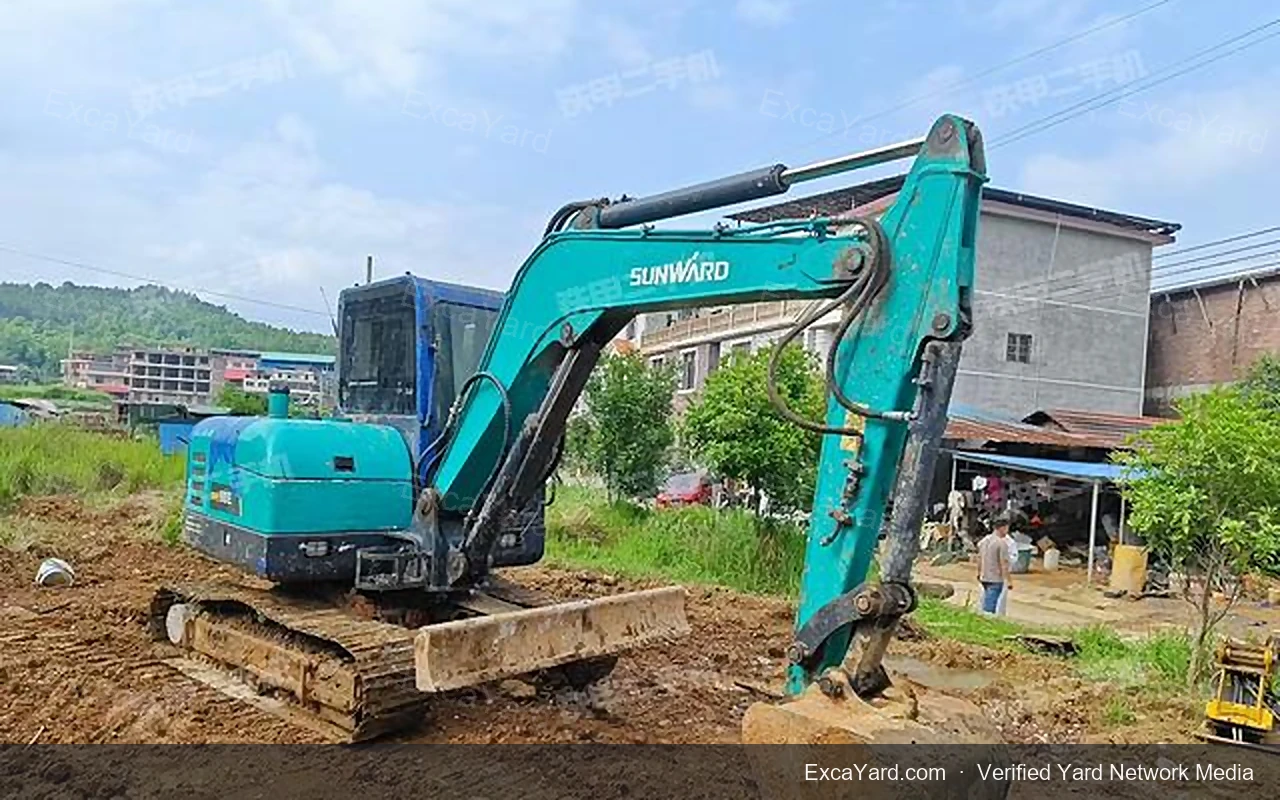
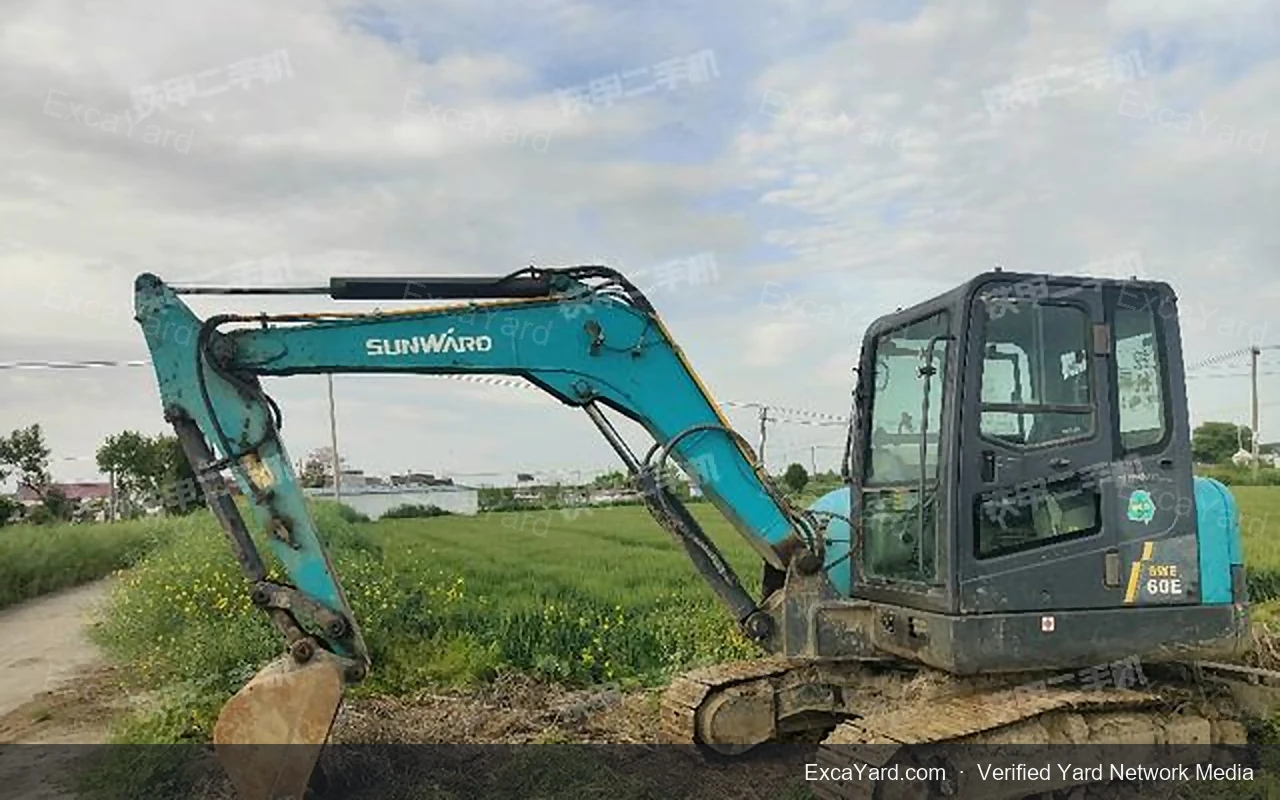
Used Sunward SWE60E Excavator: 6-Tonne Rental Economics
A used Sunward SWE60E excavator with 5,400 hours is listed at $18,500. How a 6-tonne mini pays back in rental work, what to inspect, and where the margin hides.
A used Sunward SWE60E excavator at $18,500 is a different kind of decision from buying a 20-tonne machine. Nobody buys a six-tonne mini because it is impressive. They buy it because it fits through a gate, rides on a small trailer, and can be rented to a plumber, a landscaper and a municipal crew in the same month. That makes the purchase a utilisation bet rather than a specification contest, and it should be underwritten the same way a rental company underwrites any asset: hours, days, and the cost of an idle week.
The used Sunward SWE60E excavator at a glance
| Field | Listing |
|---|---|
| Model | Sunward SWE60E |
| Year | 2022 |
| Hours | 5,400 |
| Operating weight | 6.0 t |
| Bucket | 0.3 m³ |
| Grade | A |
| Location | Yiyang, China |
| Price | $18,500 USD |
| Terms | FOB Shanghai |
The condition notes describe a well-maintained unit with no major repairs, an engine that runs smoothly, hydraulics with no leaks, undercarriage at roughly 70%, minor cosmetic wear and some surface rust on the bucket edge. Grade A for a 2022 machine with 5,400 hours is plausible: four years of use at about 1,350 hours annually is a working machine, not a showpiece.
Rental maths before brand loyalty
Most mini excavator arguments are about brand. Almost none of them should be. A six-tonne machine earns money the same way regardless of the decal: it bills by the day, burns fuel by the hour, and loses money every day it sits in the yard.
Start with the only three numbers that matter.
Cost per hour of ownership. Take the purchase price, subtract what you expect to recover at resale, and divide by the hours you expect to run before that exit. With this unit at $18,500 and a scenario of 6,000 working hours before resale at $6,000, capital cost is $12,500 ÷ 6,000 = roughly $2.08 per hour. Change the residual or the hours and the number moves — that is the point. Do not let a seller hand you a single figure.
Cost per hour of operation. Fuel, operator, grease, filters, teeth, and an allowance for repairs. These are local numbers, not brochure numbers. A machine that costs $2.08 an hour in capital and $30 an hour to run is a $32 machine, and the day rate has to clear it with margin.
Billable days per month. This is where rental businesses die. A mini at 20 billable days a month is a business. A mini at 8 billable days a month is a hobby with a diesel bill.
Write the three numbers down before you send a deposit. If the arithmetic only works at 25 days a month, the machine is not the problem — the plan is.
SWE60E price: what $18,500 has to earn back
Eighteen thousand five hundred dollars for six tonnes is about $3,083 per tonne, which looks expensive next to a 20-tonne machine at $857 per tonne. That comparison is meaningless. Small machines always carry more cost per tonne because the expensive parts — pump, valve, final drives, cab — do not shrink in proportion to the steel.
The useful comparison is against other small units in the same feed. A 2017 Sany SY75C, 7.5 tonnes with 4,685 hours and a Grade A report, is listed at $12,000. Per tonne that is $1,600, less than half the Sunward’s rate. So why would anyone pay $18,500 for the smaller, newer machine?
Three reasons, and you should be honest about which one applies to you.
The first is age. A 2022 unit is four years old, not nine. Seals, hoses and electronics have had far less calendar time to degrade, and the resale window is longer.
The second is class. Six tonnes is the sweet spot for residential and utility work: light enough for a small trailer, small enough for a backyard, still able to carry a 0.3 m³ bucket with authority. A 7.5-tonne machine is a different rental product with a different customer.
The third is condition risk. A newer Grade A machine with disclosed cosmetic wear is a lower-variance purchase. You pay for the variance reduction, whether or not you call it that.
If none of those three matter to your market, the Sany is better value and there is no shame in saying so. If you are renting to homeowners and small contractors, the Sunward’s size and year are the product.
Utilisation: the number that decides everything
Here is the useful thing about this specific unit: its own history is a utilisation data point. 5,400 hours across four years is about 1,350 hours a year, or roughly 112 hours a month. At eight hours a day that is about 169 working days; at six hours a day, about 225.
That tells you the machine was doing real work in its first life, which is a good sign for mechanical honesty and a warning for your business case. If your market cannot supply 1,300 hours a year of mini excavator work, you are buying a machine that was busier than your plan.
Two checks before you accept the hours as good news:
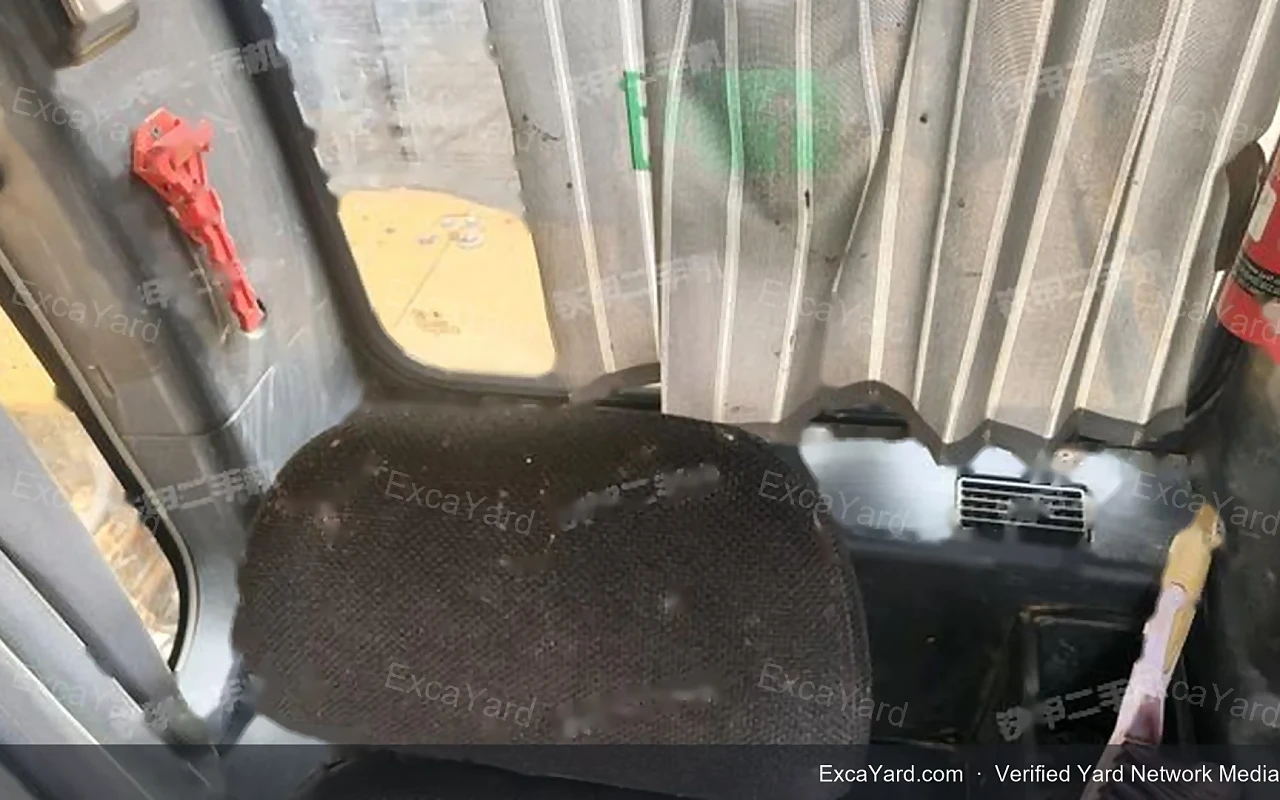
- Does the wear match? 5,400 hours should show worn pedal rubbers, a used seat, and paint loss where boots and buckets meet the machine. Clean paint and a new seat on a four-year-old rental machine are a question, not a bonus.
- Was it one operator or many? Rental machines are driven by strangers and show it in the pins, the swing play and the panel. That is not disqualifying at this price, but it changes what you inspect.
Inspecting the used Sunward SWE60E excavator at 5,400 hours
Minis are easy to make look tidy, which is exactly why a SWE60E inspection has to be mechanical rather than visual. If you are shopping for a used excavator SWE60E for sale, treat the photos as a filter and the video as the evidence.
- Cold start on camera. Four-year-old engines should start clean. Watch for hesitation and exhaust colour in the first thirty seconds.
- Full hydraulic cycle when hot. Boom, arm, bucket, swing, and both travel motors in forward and reverse. Listen for a whine that appears only after twenty minutes.
- Blade and auxiliary circuit. Many minis are bought for grading and breaker work. Confirm the blade cycles fully and, if the machine has auxiliary piping, that it holds pressure.
- Swing play. Push the bucket against a bank and watch the house-to-track movement. Loose swing on a mini is a bearing job, and it is not cheap relative to the machine’s value.
- Undercarriage at 70%. Rubber or steel, measure it. Ask for chain height and sprocket photos with a scale in frame.
- Pins and bucket. Surface rust on the bucket edge is disclosed and harmless. Elongated pin bosses are not.
- Cab, canopy and safety items. If your market requires ROPS/FOPS or a specific seat belt, confirm what is fitted before shipping. Retrofitting locally can cost more than the freight.
- Hour meter and display. Cross-check the digital display against the service records and the physical wear.
Ask for continuous video, not clips. ExcaYard runs inspection through a verified partner-yard network and does not own the yards it lists from; the report is commissioned for you and comes to you, which is the only version of an inspection worth paying for.
Site access and transport: the quiet advantage
The commercial case for six tonnes is mobility. A 6.0-tonne machine with a 0.3 m³ bucket can be moved on a light trailer behind a suitable truck, which changes your mobilisation cost and, more importantly, how many jobs you can say yes to in a week. A 20-tonne machine needs a low-bed and a plan.
The listing suggests a 40-foot container for one unit, or RoRo for multiple units, FOB Shanghai. Container loading for a mini is usually straightforward, but confirm dimensions with the boom folded or removed, and get lashing photos. If you are buying two or three for a rental fleet, ask for a mixed loading plan — the freight per machine is where fleet economics are won.
Parts and the Chinese-brand question
Sunward is a Chinese manufacturer, and the honest version of that conversation is this: the machine is priced below Japanese and Korean equivalents, the parts network is smaller than Volvo’s or Caterpillar’s, and consumables are generally available through distributors in most markets.
The listing states that common wear parts are readily available through local distributors. Verify it the way you would verify any claim: call your local supplier with the model number and ask for a filter set, a set of teeth and a hydraulic hose, with prices and lead times. Then ask what a final drive costs. The answer to that last question tells you whether the discount on the purchase price is real or borrowed from the future.
Bundle the basics before shipment: filters, a spare set of teeth, common seals, and a hydraulic hose or two in the sizes the machine uses. The invoice increase is small; the downtime avoided is not.
Exit value and the resale clock
Every used machine is a temporary position. On a 2022 unit, the exit question is easier than on a 2014: the machine will still be within the age range most buyers accept when you sell, and the hours will still be defensible if you keep records.
The risk is brand depth. A Sunward will not sell itself the way a Cat does, so plan on a longer listing period and price accordingly. If your business model depends on turning assets in twelve months, buy the badge with the deepest local demand instead — even at a higher entry price.
FAQ
Is the used Sunward SWE60E excavator still available? The used Sunward SWE60E excavator listing carries current status. Confirm before you plan a shipment around it.
Are the 5,400 hours verified? The listing states the hours were verified from the digital display and cross-checked with service records. Ask for both, plus wear photos, and judge consistency rather than trusting a single source.
Is a 6-tonne machine enough for rental? It is enough for residential, landscaping, trenching and utility work, which is the widest rental demand in most markets. It is not enough for quarry or bulk earthmoving. The mini excavator class page shows the alternatives if you need to compare sizes.
How long is the payback? It depends entirely on billable days. Work the arithmetic backwards from your local day rate and your realistic utilisation, not from a seller’s projection. We will not invent a payback number for you, because the variable that decides it is your order book.
What is included in the SWE60E price? $18,500 is FOB Shanghai. Freight, duty, inland transport and any attachment bundle are separate. Send your destination port and we will quote CIF with the loading method that fits the machine.
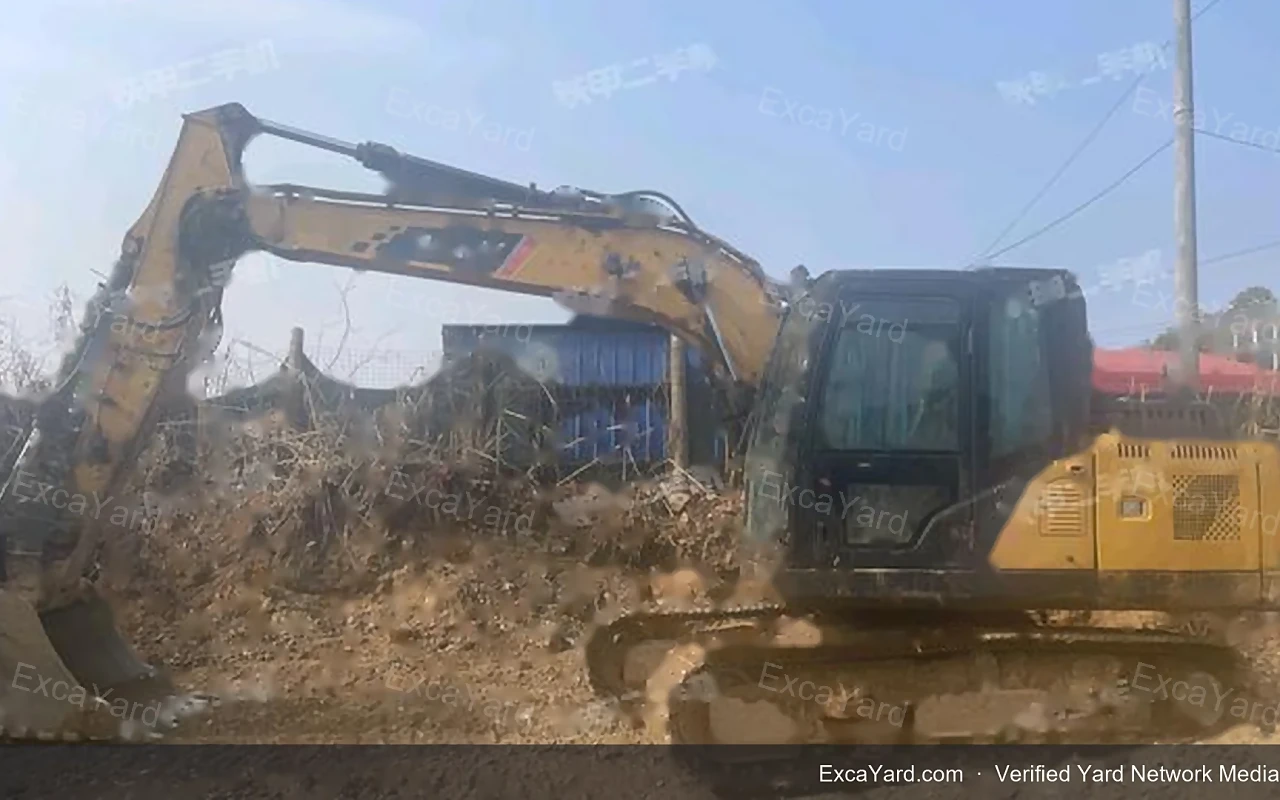
Used Sany SY135C excavator at $26,500: 13.5 tonnes and the transport argument
A used Sany SY135C excavator, 2021, 5,000 hours, Grade A, $26,500 — why the lightest machine in the group costs the most per tonne, and when transport beats bucket size.
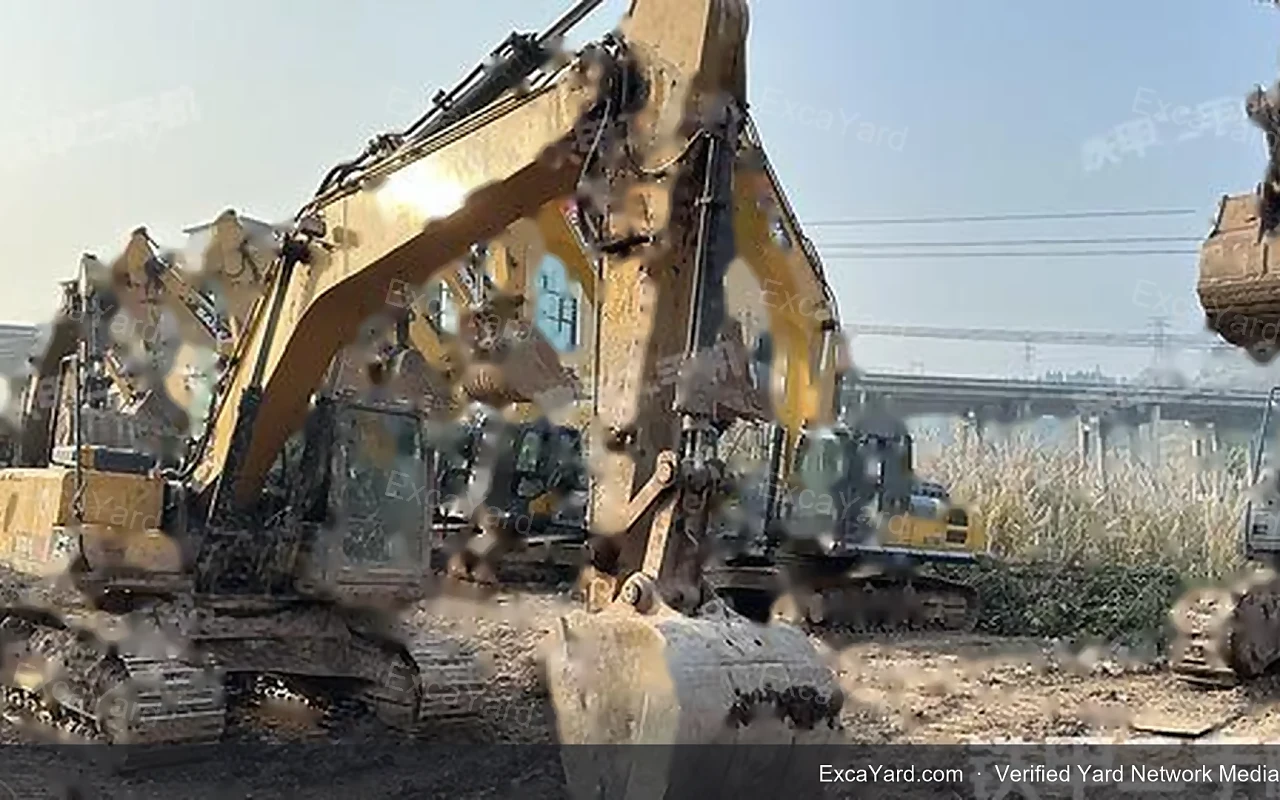
Used Sany SY200C excavator at $25,000: buying the 2022 unit for resale
A used Sany SY200C excavator, 2022, 7,800 hours, Grade A, $25,000 — how the newer 20-tonne unit compares on hours per year, grade evidence, and the resale questions that matter.
Used Sany SY205C excavator at $20,000: a 2020 20-tonne value check
A used Sany SY205C excavator with 8,500 hours, 20.5 tonnes and a $20,000 tag — what the hours, the Grade B report and the Sany parts picture really mean before a deposit.