CAT 320D vs Komatsu PC2008M0: A $12,500 Gap on 20-Ton Machines
CAT 320D vs Komatsu PC2008M0, side by side: a 2013 unit with 10,690 hours at $15,000 against a 2020 unit with 3,600 hours at $27,500. Condition, parts and buyer fit.
Two listings, same working class, seven build years apart, $12,500 apart. This CAT 320D vs Komatsu PC2008M0 comparison is not a brand argument. It is a question about which risk you would rather underwrite: an older machine with a long, visible service life behind it, or a newer machine you pay a premium to avoid inheriting someone else’s wear.
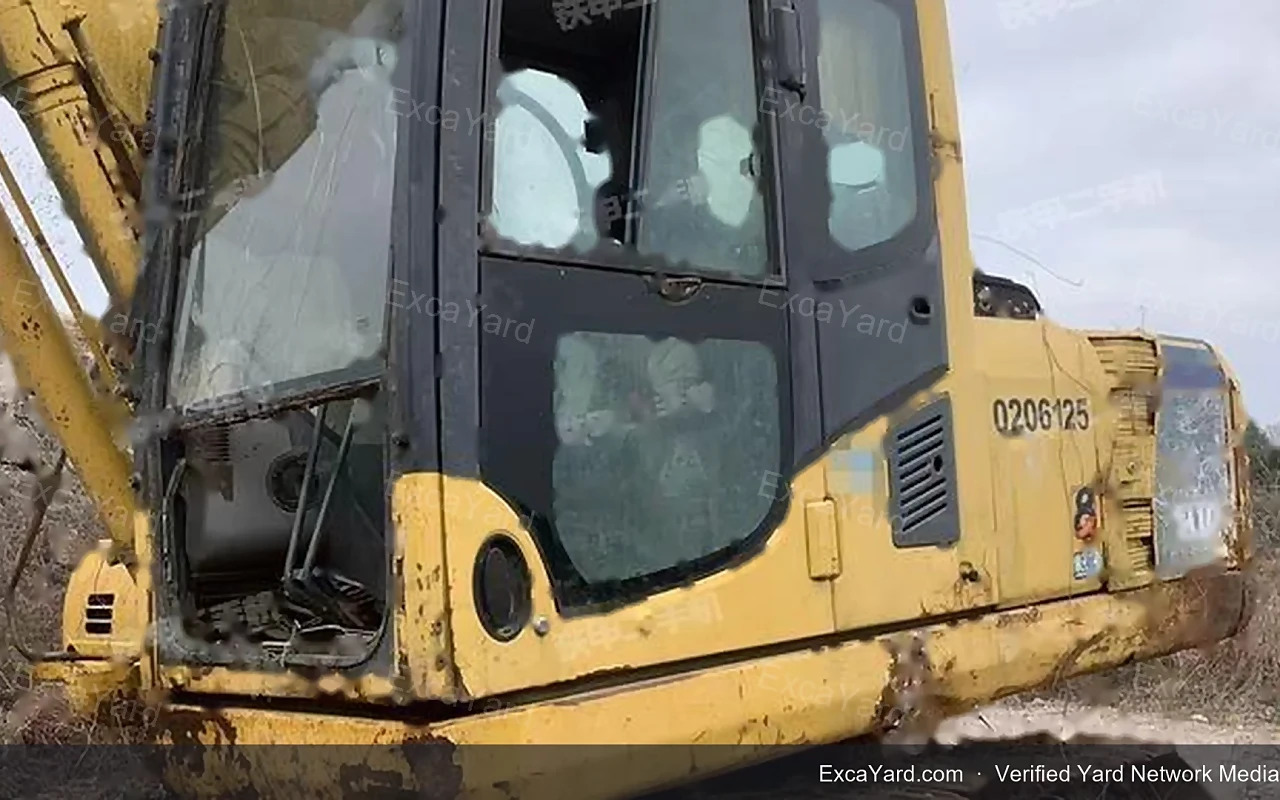
The Caterpillar is a 2013 unit with 10,690 hours on the meter, Grade B, a 1.6 m³ bucket, listed at $15,000. The Komatsu is a 2020 unit with 3,600 hours, Grade A, a 1.0 m³ bucket, listed at $27,500. Both come through the ExcaYard verified yard network, where disclosure fields are recorded after inspection rather than paraphrased. What disclosure cannot do is tell you which machine fits your job.
CAT 320D vs Komatsu PC2008M0: the two listings
| Field | CAT 320D | Komatsu PC2008M0 |
|---|---|---|
| Stock number | EXY-CATE320D-161 | EXY-KOMAPC2008M0-153 |
| Build year | 2013 | 2020 |
| Meter hours | 10,690 | 3,600 |
| Grade | B | A |
| Bucket | 1.6 m³ | 1.0 m³ |
| Price | $15,000 | $27,500 |
| Listed operating weight | 32.0 t | 20.08 t |
| Engine model | Not recorded | Not recorded |
One field needs settling first. The model names put both machines in the 20-tonne class, yet the recorded weight is 32.0 t for the Cat and 20.08 t for the Komatsu. A 12-tonne spread inside one nominal class is not a like-for-like specification. Treat the field as a lead, not a fact, and confirm the serial plate before pricing haulage or ocean space, because transport quotes are built on the plate, not the brochure.
What the CAT 320D vs Komatsu PC2008M0 gap really buys
Strip the badge and the $12,500 gap separates four measurable things.
The Komatsu is seven years younger. It has 7,090 fewer hours on the meter. It carries a Grade A disclosure instead of Grade B. And it has a smaller bucket, 1.0 m³ against 1.6 m³. The first three favour the Komatsu on wear exposure. The fourth does not favour it on production per cycle.
Divide price by recorded hours and you get $1.40 per hour for the Cat and $7.64 per hour for the Komatsu. That ratio is often quoted as if it settles the decision, and it does not. It is bookkeeping, not a wear model. The Cat’s 10,690 hours are already spent; what you are buying is whatever remains. The Komatsu’s 3,600 hours are also spent, just fewer of them. Neither number tells you the remaining life of a hydraulic pump, a swing bearing or a final drive.
A second ratio is more useful. If each machine entered service in its build year, the Cat has averaged roughly 820 hours a year and the Komatsu roughly 600. Those are assumptions, not disclosed facts, but they point somewhere useful: the older machine has not been idle, and the newer one has not been worked hard. A low annual average on a six-year-old machine can mean careful part-time use, or long standstill periods that age seals, fuel and batteries on their own schedule.
Condition: what Grade B at 10,690 hours actually means
Grade is a disclosure label, not a warranty. On this Cat, Grade B tells you the machine is expected to show honest working wear and to need attention in the consumable systems. That is a normal description for a 2013 excavator with five figures on the meter. It is not a statement that the undercarriage is finished, and it is not a statement that it is fine.
The items that decide the first-year bill on a machine of this age are predictable:
- Undercarriage: link height, bushing wear, sprocket teeth, roller surfaces, track tension.
- Pins and bushings at the boom foot, boom-to-arm and bucket linkage, measured for play rather than judged by grease presence.
- Hydraulic cylinders for chrome scoring and seal weeping, plus hose condition at the bend points.
- Cooling pack and radiator fins, especially if the machine worked in dust.
- Engine blowby, cold-start behaviour and injector response.
- Cab electrics, monitor faults and any error codes stored in the controller.
On the Komatsu, 3,600 hours moves the argument to different risks. Structural wear should be lighter; standstill risk moves up. Ask how the machine was stored, whether it was started and cycled periodically, and whether fuel and hydraulic oil were changed on time rather than on hours. A low-hour machine with original, aged fluids is not the same asset as one with fresh service.
The verification methods recorded for these two units are also different, and that difference is worth understanding. For the Cat, hours are read from the meter and cross-checked against overall wear. For the Komatsu, hours are read from the ECU and cross-checked against the service log. An ECU readout is a stronger starting point because it is harder to edit than a dash display, but it still is not a guarantee. Independent verification at inspection remains your job.

Parts: the CAT 320D vs Komatsu PC2008M0 question is local
Both brands are supportable. The useful question is not which network is bigger, because both are large. It is which brand has the part you will need, within reach, at a price you can absorb.
Caterpillar’s position on this 320D is straightforward: genuine and aftermarket parts are stocked in most regions, including Africa and Asia, and the platform is old enough that independent mechanics have seen it repeatedly. Pattern parts are common, which lowers the cost of keeping an older machine alive. The flip side is that a 13-year-old platform invites previous owners to fit whatever was cheapest, so inspect for mismatched components and non-standard repairs.
Komatsu’s position on the PC2008M0 is also strong, with parts available through local dealers and online, and common wear parts stocked. The machine is newer, so the aftermarket has had less time to fill in around it. Certain hydraulic and electronic components may be dealer-only, which affects both price and lead time.
Before either machine leaves the yard, ask two questions about parts. Which dealer or independent supplier is nearest to my site, and what is the lead time on a final drive, a hydraulic pump and a set of injectors? If any of those answers is measured in weeks, the cheap machine is not cheap and the expensive machine is not expensive. Downtime sets the real number.
Buyer fit: who should take the $15,000 CAT 320D
The Cat suits a buyer who can absorb repair work as a planned cost rather than a surprise. That usually means one of four profiles.
A contractor adding a second or third machine, where the new unit does not have to carry the whole production load in its first month. A buyer with workshop capability or a trusted local mechanic who can rebuild a cylinder or chase an electrical fault without waiting for a dealer. A buyer whose work is seasonal or below roughly a thousand hours a year, where the machine’s remaining life is consumed slowly enough that the purchase price dominates the economics. And a buyer operating in a market where the 320D is common enough that resale or cannibalisation is realistic.
The 1.6 m³ bucket is a genuine advantage for bulk work, provided the material and the transport plan allow it. It also raises the question of how the machine will be moved, since bucket width can decide whether a container is even possible, which is why the shipping decision belongs before the deposit.
What the Cat does not suit is a buyer who needs guaranteed availability from day one with no repair reserve. A $15,000 machine that needs $10,000 of work in year one was never a $15,000 machine. Budget the reserve in cash, not in optimism.
Buyer fit: who should take the $27,500 Komatsu PC2008M0
The Komatsu suits the opposite profile. It is the machine that has to run, not the machine that has to be affordable.
That means a buyer with continuous work and a contractual penalty for late completion. A buyer running one machine and needing it at high annual hours. A buyer whose operators are used to Komatsu hydraulics and who values fine control in grading or trenching. A buyer who prefers a newer unit because the financing, insurance or client requirement points that way.
The 1.0 m³ bucket is the honest trade. Fewer cubic metres per pass than the Cat, in exchange for a lighter duty cycle on the same class of machine. If your work is utility, trenching, site preparation or rental with mixed operators, that trade is usually acceptable. If your work is mass excavation measured by the cubic metre, the smaller bucket is a real production cost that you should price into the decision rather than discover in month two.
Do not assume the newer machine automatically holds value better. What it may hold better is availability and buyer interest, because the next buyer also prefers low hours. That is a market preference, not a guarantee.
Inspection before deposit: where the two diverge
On the Cat, spend the inspection time on wear. Measure the undercarriage rather than photographing it. Check for cracks around the boom foot, the stick top and the bucket linkage. Confirm the hour meter agrees with pedal, seat and joystick wear. Ask for a cold start on video, with the machine at rest overnight, because a warm engine hides blowby and injector problems.
On the Komatsu, spend the time on consistency. Compare the ECU hours with the service log, then compare both with physical wear. A 3,600-hour machine should not have a worn-out undercarriage or a resealed boom. Check for fault codes, verify that the hydraulic system reaches operating temperature without noise, and confirm that the hour reading is from the controller rather than a replacement display.
On both, insist on three things: a walkaround video with the engine running, a cold-start clip, and a pressure test on the main circuits. If a seller resists any, the price is not the problem.
FAQ: CAT 320D vs Komatsu PC2008M0
Is the CAT 320D vs Komatsu PC2008M0 gap mostly about age?
Mostly, but not entirely. Seven years and 7,090 hours explain a large part of the $12,500. The grade difference, A against B, explains more. The rest is market positioning: the 320D is a mature platform with a deep aftermarket, and the PC2008M0 is a newer unit with less independent support. You are paying for both condition and convenience.
Which machine is cheaper to own?
There is no honest single answer without your utilisation, your local parts prices and your labour cost. What can be said is that the Cat front-loads risk into the purchase and the Komatsu front-loads it into the price. A buyer with a workshop should price both on total cost over the hours they will actually run.
Can the hours on either machine be trusted?
The methods differ, and both have limits. The Cat’s hours come from the meter and are checked against wear. The Komatsu’s come from the ECU and are checked against the service log. Neither replaces an independent inspection, so let the undercarriage and the hydraulic system tell you whether the hour claim is plausible.
Which one is easier to resell?
In most export markets the Cat 320D is the easier name to sell, because the platform is everywhere and mechanics know it. The Komatsu is easier to sell to a buyer who specifically wants low hours. Check what your local market actually runs before assuming either.
Next step
The full CAT 320D listing carries the recorded fields and photographs for the 2013 unit. The Komatsu PC2008M0 listing does the same for the 2020 machine. If you want both inspected against the same checklist before you choose, compare CAT 320D vs Komatsu PC2008M0 stock across the verified yard network, or tell us your site conditions and budget and we will tell you which of the two we would put on your job.
Cat 320 vs Komatsu PC200: Honest Comparison for Used Buyers (2026)
Choosing between a used Cat 320 and a used Komatsu PC200? Real-world differences in fuel economy, parts availability, resale value, and operating cost for export buyers.

Used Caterpillar 320D Excavator at $15,000: Unit Economics and Inspection
Used Caterpillar 320D excavator, 2013, 10,690 hours, Grade B, $15,000. Run the unit economics first, then inspect the five systems that decide whether the machine pays for itself.

Used Komatsu PC2008M0 Excavator: The Real Cost of a $27,500 Machine
A used Komatsu PC2008M0 excavator at $27,500 with 3,600 hours. Ownership cost per hour at three utilisation levels, how the PC2008M0 price compares with its class, and the inspection lines that matter.